
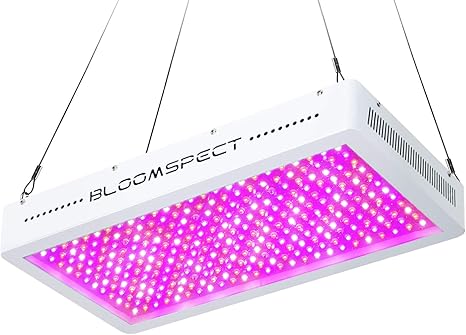
BLOOMSPECT 3000W LED Grow Light Full Spectrum Indoor Plant Lamp with 300pcs 10W LEDs
Category: Grow Lights
Check Current PriceBuy the Mars Hydro TS 3000 for higher canopy PPFD; pick BLOOMSPECT for lower upfront cost. The TS unit delivers denser light, while BLOOMSPECT emphasizes broad coverage and cooling. Both products target Grow Lights users who need reliable indoor plant illumination.
BLOOMSPECT 3000W LED vs Mars Hydro TS 3000 performance comparison
Mars Hydro TS 3000 usually provides stronger usable light at canopy than BLOOMSPECT 3000W LED Grow Light. The TS unit uses higher actual draw and denser diode arrays to raise PPFD across a 3×3-4×4 flowering canopy. BLOOMSPECT 3000W LED Grow Light emphasizes coverage and claims cooler running temperatures with many diodes and large heatsinks. This performance split means growers choose the TS for maximum flower intensity and BLOOMSPECT for wider, cooler coverage at budget price.
- BLOOMSPECT 3000W specifications: 300 x 10W LEDs, nominal 3000W equivalent, rated power draw 540W, recommended coverage veg 5×5, flower 4×4
- Mars Hydro TS 3000 typical specs: advertised 450W actual draw, Samsung LM301-type diodes, recommended coverage veg 4×4, flower 3×3-4×4
- Cooling and controls: BLOOMSPECT claims large aluminum sinks plus fan cooling lowering temps by 60 F according to marketing, TS 3000 uses passive bars and distributed fanless design on some SKUs
How does LED spectrum tuning affect flowering yields indoors?
LED spectrum tuning increases flowering yields by optimizing red and far-red photon ratios. The red-heavy spectrum (around 660 nm) drives photosystem response and supports bud formation, while far-red shifts flowering timing via phytochrome signals. BLOOMSPECT 3000W LED includes a full spectrum mix (red, blue, white, IR) and VEG/BLOOM switches to shift energy toward growth or flower. The TS 3000 typically uses a broad white-centric spectrum with high-efficiency diode bins that also support good flower response when paired with supplemental red.
Energy efficiency and heat management for 3000W-class LEDs
BLOOMSPECT 3000W LED Grow Light trades apparent nominal wattage for efficiency by spreading many diodes across a wide plane. The fixture lists 300 LEDs of 10W each but specifies a rated power draw of 540W, which means lower wall energy than a true 3000W HID. Mars Hydro TS 3000 usually draws around 450W, so the TS often runs cooler per area under similar canopy distances. Practical heat management outcomes depend on hanging height, room ventilation, and active cooling choices.
- BLOOMSPECT cooling offers: vent holes, large aluminum heat sinks, high-speed fan (marketing claims 60 F lower running temp)
- Power draws for cost planning: BLOOMSPECT rated draw 540W; Mars Hydro TS 3000 typical draw 450W
- Coverage guidance: BLOOMSPECT recommended coverage veg 5×5 and flower 4×4; TS guidance commonly veg 4×4 and flower 3×3-4×4
What are realistic electricity costs for a full flowering cycle?
A 56-day flowering run costs about $47 with BLOOMSPECT 3000W LED Grow Light at $0.13/kWh. I calculate that by 0.54 kW draw 12 hours per day = 6.48 kWh daily, times 56 days equals 362.9 kWh, then multiplied by $0.13 per kWh. A comparable TS 3000 run costs about $39 under identical assumptions because 0.45 kW 12 hours yields 5.4 kWh daily. These calculations show TS saves roughly $8-$20 per typical run versus BLOOMSPECT depending on run length and local utility rates.
BLOOMSPECT 3000W LED vs Mars Hydro TS 3000 value and practicality
BLOOMSPECT 3000W LED Grow Light offers a low sticker price of $169.99 while advertising broad coverage and active cooling. The lower cost makes BLOOMSPECT attractive to entry-level growers and larger arrays where fixture count matters. Mars Hydro TS 3000 often costs more but delivers higher photon efficacy and higher canopy PPFD per watt in many independent tests. Buyers should balance upfront costs, expected yield per run, and long-term electricity and cooling costs.
Practical offers for hobby growers and small farms
- Dimming and veg/flower switches allow intensity control and spectrum shift for different growth stages
- Driver quality and warranty reduce downtime and protect investment (BLOOMSPECT lists 2-year warranty)
- Mounting and footprint choose fixtures sized to your tent, bench, or greenhouse layout
- Safety certifications and connectors ensure UL/ETL listings and reliable power plugs for commercial installs
Which fixture offers matter most for hobby growers and small farms?
Dimmable drivers allow growers to tailor light intensity and reduce energy during veg. Good heat sinks and low-noise fans reduce HVAC load and improve room temperature stability. Coverage uniformity matters more than raw wattage for small rooms because hotspots reduce usable canopy area. A clear warranty and return policy (BLOOMSPECT offers two years and 30-day money-back) lowers risk for first-time buyers.
Key follow-up searches buyers will make include yield per fixture, hang height guidance, and real PPFD numbers. Expect questions like “How many grams per watt can I expect?” and “What hang height gives even coverage?” I answer those by recommending PPFD measurement with a quantum meter and starting hang heights of 18-24 inches, adjusting to target canopy PPFD ranges for species. Also ask “Do I need extra red or UV?” and note that targeted supplemental bars can improve terpene and resin production for flowering crops.