
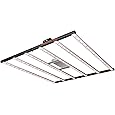
AC Infinity IONFRAME EVO8 Samsung LM301H EVO Bar LED Grow Light 5×5 730W Full Spectrum Commercial Plant Light
Category: Grow Lights
Check Current PriceAC Infinity IONFRAME EVO8 Samsung LM301H EVO Bar LED Grow Light 5×5 delivers commercial-grade output. It combines 730W, 2688 diodes, and 3.14 mol/J efficiency for deep canopy penetration. Grow Lights shoppers benefit from UIS WiFi control and ETL certification.
AC Infinity IONFRAME EVO8 performance vs HLG and Fluence
For Grow Lights, AC Infinity IONFRAME EVO8 uses dense bar spacing to produce broad, even coverage across 5×5. HLG favors quantum-board designs for wide soft light; Fluence favors optics and tighter arrays for focused penetration. The reviewed AC Infinity IONFRAME EVO8 grow light lists PPE 3.14 mol/J and PPFD 2013 across test points. Those specs typically yield more even canopy PAR than some single-source, high-intensity competitors in similar footprints.
How do PAR output and uniformity compare in real grow rooms?
AC Infinity LED grow light produces 2013 mol/m /s PPFD at manufacturer center test points. That results from 2688 Samsung LM301H EVO diodes arrayed with algorithmic spacing for uniformity. HLG quantum boards often trade slightly lower peak PPFD for softer, broader PAR coverage. Fluence fixtures use optics to push light deeper but sometimes concentrate PAR into narrower footprints.
Running costs and thermal performance of HLG and Fluence LEDs
Expect lower operating costs and cooler rooms with HLG and Fluence compared to HID fixtures. IONFRAME EVO8 grow light draws 730W, which reduces heat and electrical load versus 1000W HPS. Fluence often customizes spectra and optical control, sometimes requiring denser heat sinks for heat dissipation needs. HLG’s board-style fixtures commonly use passive cooling to stay fanless in hobby and many commercial applications.
What are realistic electricity savings running LEDs in a 4×4 tent?
IONFRAME reduces consumption by 500W versus 1000W HPS when using the AC-IF6K 4×4 model. At a 12-hour photoperiod, that saves six kilowatt-hours daily and roughly 180 kilowatt-hours monthly. At $0.15 per kWh, growers save about $0.90 daily and roughly $27 monthly on electricity. Lower fixture heat also trims HVAC demand, typically dropping cooling energy by 20-40 percent in tight rooms.
AC Infinity IONFRAME EVO8 build quality and mounting vs rivals
The 5×5 full-spectrum commercial LED grow light uses modular aluminum rails, a removable driver, and ETL certification. That frame simplifies mounting height changes and dampens vibration more than many single-sheet panel options. This AC Infinity IONFRAME EVO8 grow light supports daisy-chaining up to 80 fixtures via removable driver. Fluence and HLG often supply robust proprietary mounts, which can complicate interchangeability for multi-tier racks.
Which mounting hardware works best for multi-tier racks and tents?
IONFRAME mounts with adjustable ratchet hangers deliver precise height control and vibration reduction. For multi-tier racks, use Unistrut or steel T-slot rails with rated quick links, chain, and safety cables. Specify hardware rated at least twice the total fixture weight; load rating equals safe working load. For tents, heavy ratchets and carabiners speed adjustments and help when training canopy branches manually.
Recommended mounting components for multi-tier racks and tents
- Unistrut or T-slot steel channel sturdy backbone for stacked fixtures and even load distribution
- Rated quick links or M10 (3/8″) carabiners secure, removable connection points
- Industrial ratchet hangers rated 200 lb each fast height adjustments with safety margin
- Safety cable, 3/16″ stainless steel, rated >1000 lb secondary fall protection
- M10 threaded rod or zinc-plated hardware for permanent rack builds corrosion-resistant and strong
Follow-up questions buyers search next
Which brand fits a 5×5 room; choose the reviewed AC Infinity IONFRAME EVO8 for PPE, controls, and value. Do spectral differences matter; Fluence targets crop-specific spectra while HLG emphasizes broad PAR for general growth. ROI depends on rates and yield; expect one to three years in most small commercial scenarios.