
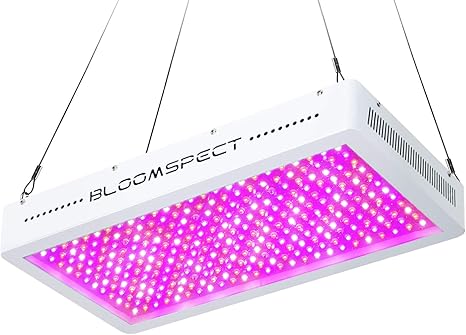
BLOOMSPECT 3000W LED Grow Light Full Spectrum Indoor Plant Lamp with 300pcs 10W LEDs
Category: Grow Lights
Check Current PriceYes the BLOOMSPECT 3000W often proves overpowered for tiny hobby hydroponic closets. It draws 540W actual power and best fits 4×4-5×5 tents or small rooms. Many new growers search Grow Lights that balance coverage, heat, and energy consumption.
BLOOMSPECT 3000W LED performance for small hydroponic setups
BLOOMSPECT 3000W LED Grow Light (Full Spectrum) delivers wide-spectrum light but often exceeds the needs of very small grows. The fixture claims a nominal 3000W LED configuration while the listed rated power draw is 540W, so electrical demand remains moderate despite the marketing wattage. New growers should note manufacturer coverage suggestions: 5×5 feet for vegetative growth and 4×4 feet for flowering, which suits tents or small dedicated rooms. The missing PPFD and fixture dimensions leave canopy uniformity and usable photon density uncertain for precise yield forecasting.
- Series: B3000
- LED configuration: 300 x 10W (nominal 3000W)
- Rated power draw: 540W
- Spectrum: Full spectrum (Red, Blue, White, IR)
- Recommended coverage: 5×5 ft (veg), 4×4 ft (flower)
How does the light spectrum affect growth stages in practice?
BLOOMSPECT 3000W LED accelerates vegetative compactness and supports stronger flowering responses when spectrum matches stage. The mix of blue, red, white, and IR helps plants balance leaf development and bud formation because blue light reduces stretch while red light stimulates flowering hormones. PPFD (photosynthetic photon flux density) means the number of usable photons hitting a square meter each second, and growers need that number to compare fixtures accurately. Without published PAR or PPFD data for the unit, expect practical differences only after measuring canopy photon density with a PAR meter. Using the VEG/BLOOM double switch, novices can shift spectral emphasis for seedlings or bloom cycles for practical stage control.
Cost, heat, and installation considerations for hobby hydroponics
BLOOMSPECT 3000W LED Grow Light (Full Spectrum) lists a street price near 169.99 USD, making the fixture an inexpensive electrical purchase for a 4×4 tent. The true operating cost depends on the rated draw of 540W and your local electricity rate; at $0.13/kWh the lamp running 18 hours daily costs about $37.90 monthly. Cooling hardware, ventilation, and safe mounting hardware drive additional expenses because the product lacks listed dimensions, hanging hardware, and certified input connector details. Warranty coverage of two years and a 30-day money-back policy help manage initial risk for first-time builders, but missing safety certifications should prompt cautious installation choices.
Essential installation checklist and ventilation numbers for hobby growers
- Price: 169.99 USD (retail)
- Electric draw: 540W rated
- Cooling includes: vent holes, large aluminum heat sinks, high-speed fan (manufacturer claims up to 60 F lower running temp compared to HPS)
- Missing specs to confirm: dimensions, input voltage, power connector type, PPFD/PAR data, safety certifications
- Recommended accessories: hanging ratchets, inline fan (see CFM examples below), thermostat controller, PAR meter
Can a small closet or 2×2 tent handle the heat output?
BLOOMSPECT LED Grow Light exceeds passive-ventilation cooling capacity in most small closets without active exhaust ventilation. The fixture converts nearly all 540W of electrical input into usable light and waste heat; that equals roughly 1,842 BTU/hour (540W 3.412 Btu/hr per Watt). For a 2×2 tent (for example 2 ft 2 ft 5 ft = 20 cubic feet), targeting 20-30 air exchanges per hour requires only about 7-10 CFM, but real-world setups need higher CFM to remove LED heat and humidity spikes. I recommend a small inline fan rated 100 CFM with a thermostat controller for closets and a 150-300 CFM fan for 4×4 tents, plus ducting and a carbon filter if odor control or HVAC connection is required. If you cannot add reliable exhaust, choose lower-wattage fixtures made for micro-closets to preserve canopy temperature and humidity control.
BLOOMSPECT 3000W LED yield expectations and ROI for hobbyists
BLOOMSPECT 3000W LED Grow Light (Full Spectrum) can produce strong results for leafy herbs or small flowering crops when growers achieve even canopy PPFD and adequate climate control. The fixture s cost of 169.99 USD is low relative to commercial LEDs, but calculate running costs using the 540W draw; at $0.13/kWh and an 18-hour daily schedule, monthly electricity totals roughly $38. That operating cost plus ventilation and cooling expenses determine payback for higher-value crops like microgreens versus low-dollar herbs. Missing published PPFD or PAR measurements prevents precise yield-per-square-foot estimates, so growers should measure actual light at canopy level using a handheld PAR meter before expecting specific harvest numbers.
- Initial cost: 169.99 USD
- Rated electrical draw: 540W
- Estimated monthly energy (18 h/day at $0.13/kWh): $38
- Manufacturer warranty: 2 years; return policy: 30 days money-back
Will switching to a higher-output LED increase yields for basil?
3000W LED Grow Light for Veg and Flower increases basil biomass only when it raises canopy PPFD into the plant s optimal range. For basil, useful target PPFD values typically sit between 200 and 400 mol/m /s; raising average canopy PPFD from 150 to 300 mol/m /s can shorten time-to-harvest and increase leaf mass. The reviewed fixture lacks published PPFD, so swapping lights without measured PAR gains may not improve yields. Practical advice: measure current canopy PAR, calculate desired PPFD, and add fixtures or raise lamp height to reach even illumination; otherwise, invest in multiple lower-wattage fixtures for uniform coverage.
Practical follow-up questions hobby growers search next
How many plants fit under this fixture, and how long should I run lights? The covered footprint suggests 4×4 flowering space; run 16-18 hours daily for basil and 12 hours for flowering crops. Do I need a PAR meter, and why? Yes PPFD (PAR measurement) tells you actionable light intensity at canopy level and prevents wasted spending. Should I choose this lamp over multiple smaller LEDs? Choose multiple smaller fixtures if you need better uniformity across a canopy or easier heat distribution; the single large fixture suits compact rooms with good ventilation.