
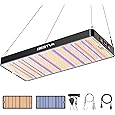
Buy the KINGLED KP4000 LED Grow Lights for strong 400W flowering performance. It delivers high PPFD and a full bloom-focused spectrum. These Grow Lights work well in 4×4 and 5×5 tents for flowering cycles.
KINGLED KP4000 vs other 400W LED lights for flowering yields
For flowering yields, the KINGLED KP4000 LED Grow Lights delivers intense canopy PAR that often outperforms many other 400W fixtures. It produces very high PPFD close to the light and a broad full spectrum optimized for bloom. The KP4000’s 2,304 LEDs increase usable light in the flowering canopy versus typical 400W panels. Growers see thicker buds when they manage distance and canopy uniformity properly.
KINGLED KP4000 key performance specifications
- Power draw: 400W
- Input voltage: AC100-240V
- LED count: 2304 total (red 256, blue 256, white 896, yellow 896)
- Spectrum: 460 nm (blue); 3000K-5000K (white); 660 nm (red)
- PPFD: 2350 mol/s measured at 6 inches
- Recommended coverage: 4×4 ft to 5×5 ft
How does spectrum and PPFD affect bloom phase yield?
KINGLED LED Grow Lights increase canopy PAR and boost bud mass and resin. PPFD (photosynthetic photon flux density) measures photons plants use per second for photosynthesis. Blue 460 nm drives compact vegetative structure while red 660 nm encourages flowering and flower expansion. Managing distance to avoid light saturation and preserving canopy uniformity yields the best harvests.
Evaluating efficiency and spectrum across 400W LED grow brands
KINGLED KP4000 LED Grow Lights deliver strong PAR but omit published efficacy ( mol/J) figures buyers want. Many 400W brands such as Mars Hydro, Spider Farmer, and Viparspectra list LED counts and spectra. KP4000’s 2,304 LEDs and multiple diode colors favor bloom performance but lack mol/J efficiency data. Practically, choose fixtures that publish PPFD maps, efficacy, and real-world canopy coverage for accurate comparisons.
Metrics buyers should compare when choosing a 400W fixture
- Efficacy in mol/J (higher values mean more photons per watt)
- PPFD maps across a tent footprint at multiple heights
- Spectrum breakdown and presence of 460 nm and 660 nm peaks
- LED count and diode type (COB, SMD, multi-chip) and thermal design
- Warranty length, demonstrated lumen maintenance, and safety certifications
What installation and canopy coverage should I plan for?
KP4000 LED Grow Light covers 5×5 feet for flowering when hung correctly. For initial setup, start higher and lower the fixture until you reach target PPFD with no bleaching. Target canopy PPFD for flowering typically sits in the high hundreds to low thousands mol/m /s depending on strain. Use a PAR meter and move lights in 2-4 inch steps to tune average canopy values.
KINGLED KP4000 durability, heat and warranty vs rivals
KINGLED KP4000 Grow Lights use aluminum sinks, quiet fans, and include three-year service and 90-day returns. The unit lists an operating temperature range of 50 F-60 F and claims effective heat dissipation with metal housing. Many rivals offer similar cooling but vary in fan quality, housing metal, and warranty length. Practically, prioritize certified safety listings and documented long-term lumen maintenance when choosing durable LEDs.
Can heat, noise and maintenance costs change grow outcomes?
KP4000 reduces heat stress and lowers active cooling compared to HPS (high-pressure sodium) lamps. The KP4000 uses high-speed mute fans, lowering noise and fan replacement frequency. Excess heat requires AC or ventilation, increasing electricity and equipment costs during flower. Routine dusting, keeping fans clear, and monitoring drivers reduce failures and preserve lumen output.
Common follow-up questions about KP4000 and 400W LEDs
How high should I hang the KP4000 during bloom? A reasonable starting height is 18-30 inches for high-output arrays, then adjust by PAR readings. Strains with thin leaves tolerate stronger light closer to the canopy. Monitor leaf tips for bleaching and reduce intensity or raise the fixture if bleaching appears.
Will the KP4000 save electricity versus a 400W HPS system? LEDs typically use less electricity for equivalent usable PAR because they convert power more into usable photons and emit less infrared heat. Without published mol/J numbers for this unit, quantify savings by measuring your utility while running each system under the same schedule.
Do I need a PAR meter and tent adjustments for best yields? Yes PPFD meters provide objective canopy numbers, letting you tune distance and fixture count to avoid hotspots and light stress. Combine meter measurements with plant observations for optimal flower development and to justify adding ventilation or additional fixtures.