
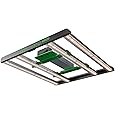
MARS HYDRO TSW2000 LED Grow Light 300W Full Spectrum Dimmable Daisy Chain
Category: Grow Lights
Check Current PriceChoose the Spider Farmer SF-3000 for higher photon efficiency, or the Mars Hydro TSW2000 for value. The SF-3000 often uses premium Samsung diodes while the TSW2000 adds daisy-chain and wide reflector benefits. Both model choices suit home gardeners shopping for Grow Lights.
Comparing MARS HYDRO TSW2000 vs Spider Farmer SF-3000 Performance
The MARS HYDRO TSW2000 LED Grow Light 300W Full-Spectrum Dimmable (Daisy Chain) emphasizes uniform canopy distribution while the Spider Farmer SF-3000 emphasizes higher photon efficacy. I describe how photon delivery and spectral balance differ between these fixtures so you can match them to your canopy. PAR and PPFD matter for plant growth; I define those terms and show practical tradeoffs for Grow Lights below.
How do PAR output, spectrum and canopy penetration compare?
MARS HYDRO TSW2000 delivers broad-spectrum light with an emphasis on even PPFD across the canopy. PAR (photosynthetically active radiation) measures light plants can use; PPFD ( mol/m2/s) measures photons hitting the canopy per second. Spectral balance matters because blues drive compact veg growth and reds/IR drive flowering and stretch; the two fixtures prioritize those bands differently.
- Input power: 300W (listed for TSW2000)
- LED count: 704 SMD LEDs on the TSW2000
- Spectrum: 3200-4200K and 5200-6800K plus 730-740nm red/IR
- Dimming: 0-100 and daisy-chain support up to 50 units
Spider Farmer SF-3000 typically emphasizes high-efficiency Samsung diodes and a tighter, more intense central PPFD footprint, which improves canopy penetration in single-fixture setups. If you need wide uniform coverage across a mixed canopy, the reviewed MARS HYDRO TSW2000 grow light helps reduce hot and cold spots. If you want maximum photons per watt for deeper penetration, consider the Spider Farmer unit instead for denser flowering canopies.
Selecting the Best LED Grow Light for Medium Indoor Gardens
The MARS HYDRO TSW2000 often fits growers who need predictable 3×3 bloom and 4×4 veg coverage while balancing price. I compare real-world tent and canopy use so you can choose for medium indoor setups without guesswork. I include mounting, airflow, and multi-unit tactics so your Grow Lights match your tent, not just the box specs.
Which fixture suits a 4×4 tent for flowering yields?
Spider Farmer SF-3000 produces stronger central PPFD and often yields better single-fixture flower-stage results in a 4×4 tent. For a 4×4 bloom area, aim for average canopy PPFD of 600-900 mol/m2/s depending on strain; higher-intensity strains prefer the top end. The TSW2000 Grow Light spreads light more evenly and can reduce edge-sag, which benefits multi-plant layouts and mixed-height canopies.
Practical setups differ by budget and plant count; a single high-efficacy SF-3000 or two distributed TSW2000s can both hit target photon budgets. If you grow five to nine plants with medium stretch, the reviewed MARS HYDRO TSW2000 grow light used in pairs gives more uniform canopy illumination. If you run fewer, heavy-yielding plants, the Spider Farmer option often concentrates usable photons where your flowers form.
Power Draw and Costs: MARS HYDRO TSW2000 vs Spider Farmer SF-3000
The MARS HYDRO TSW2000 lists 300W input power, so electrical planning and heat management must account for that draw. I show cost examples and runtime assumptions so you can estimate three-year operating expenses for each fixture. These figures let you compare upfront price versus lifetime operating cost for your Grow Lights investment.
What are expected electricity costs over a three year run?
MARS HYDRO TSW2000 consumes 300W nominal and therefore produces predictable energy use over long runs. I calculate costs using clear assumptions so you can adapt numbers to your local rates and schedules. Assume 12 hours light per day, 365 days per year, and a sample electricity rate of $0.13 per kWh to model costs below.
- Nominal wattage: 300W (0.300 kW) per fixture
- Daily runtime: 12 hours 3.6 kWh per day per fixture
- Annual use: 3.6 kWh 365 = 1,314 kWh per year
- Three-year total: 1,314 kWh 3 = 3,942 kWh per fixture
At $0.13 per kWh the three-year operating cost for a 300W fixture equals about $512.46. If you run two fixtures or different hour schedules, multiply by the number of fixtures and hours; changing the per-kWh rate to your local tariff gives a precise estimate. The Spider Farmer SF-3000 typically lists similar nominal wattage, so its energy bill under identical use assumptions will be comparable unless its actual draw or duty cycle differs in lab testing.
Common follow-up questions buyers search next
How many SF-3000s do I need for a mixed 4×4 canopy is a frequent question; two medium-efficacy units or one high-efficacy fixture can suffice depending on spacing. Measure canopy PPFD with a cheap PAR meter to confirm and adjust height accordingly. Matching fixture lensing and hang height improves uniformity without wasting photons.
What maintenance and cooling do these fixtures require is another popular query; both need clean panels, active tent ventilation, and adequate clearance for heat. Use a 4-6 inch inline fan for typical 4×4 tents and monitor canopy temperature after installation. Proper airflow prevents light burn and preserves driver lifespan.
Which driver or dimming approach works best for long-term use matters to many buyers; constant-current drivers with proper dimming ports prolong LED life. Daisy-chain only when you understand branch circuit loads and verify your outlet amperage. If you plan a multi-unit floor, consult an electrician for safe circuit planning and use thicker gauge power leads for long runs.