
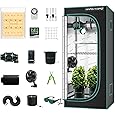
MARS HYDRO TS1000 3×3 Grow Tent Kit Complete System 150W Programmable Dimmable Grow Lights
Category: Grow Lights
Check Current PriceChoose the MARS HYDRO TS1000 3×3 Grow Tent Kit for higher light output. It supplies 150W and a wide 120 reflector for better canopy coverage. If you prefer lower draw, Spider Farmer SF1000 Grow Lights save electricity.
Comparing MARS HYDRO TS1000 and Spider Farmer SF1000 Performance
The MARS HYDRO TS1000 delivers stronger raw photon output, while the SF1000 emphasizes photons per watt efficiency when used as Grow Lights. The TS1000 uses many LEDs and a broad reflector to flatten light across a 3×3 footprint, which raises uniformity near edges. The SF1000 typically uses Samsung diodes and a tighter dense array to give more useful PAR per input watt. Growers who value absolute canopy saturation choose the higher-watt option, while those tracking electricity costs favor higher-efficacy fixtures.
- MARS HYDRO TS1000: 150W nominal, 354 LEDs, 120 white reflector, dimmable 0-100
- Spider Farmer SF1000: 100W nominal, Samsung LM301-style diodes, dimmable, built for 2×2-3×3 footprints
How do PAR distribution and PPFD maps compare in a 3×3 tent?
MARS HYDRO TS1000 produces higher center PPFD than the SF1000 across a 3×3 layout. PAR (photosynthetically active radiation) means the light spectrum plants use, and PPFD measures photons hitting a surface per second. The TS1000 s wide reflector smooths edge drop-off, while the SF1000 often shows higher average PPFD per watt at the center. For practical use, TS1000 achieves fuller coverage, and SF1000 delivers more efficiency for the same area.
Best grow light choice for a 3×3 tent: coverage and PAR
TS1000 Grow Light Kit suits growers who want full 3×3 coverage and strong flowering PAR across the canopy. The kit s higher wattage and reflector push PPFD toward the 3×3 tent corners, reducing the need for light boosters. If your priority is strict power budget or cooler fixtures, choose the SF1000 for more PPFD per watt near center. Consider canopy density and final light targets when selecting a fixture for a 3×3 tent.
What mounting height and reflector setup work best in a 3×3 tent?
Spider Farmer SF1000 performs best at 16-22 inches above an average canopy for balanced coverage. Mount lower, around 12-16 inches, for heavy flower stages with the TS1000 to reach flowering PPFD targets. Use a reflective tent interior, such as 1680D mylar, to increase canopy PPFD and reduce hot spots. Adjust height gradually, measuring PPFD with a meter to meet your crop s light needs.
Recommended PPFD targets and mounting guidelines for 3×3 tents
- Vegetative PPFD target: 200-400 mol/m /s
- Flowering PPFD target: 600-900 mol/m /s
- Typical TS1000 flower mounting: 12-18 inches above canopy
- Typical SF1000 flower mounting: 16-22 inches above canopy
Energy use and heat in MARS HYDRO TS1000 vs SF1000
Programmable 150W Grow Lights for 3×3 Tents use more electricity and emit more heat than lower-watt fixtures. The TS1000 s 150W draw creates higher ambient tent temperature than a 100W SF1000 under identical ventilation. The included tent kit fans and carbon filter in the TS1000 kit help manage heat and odor in a small 3×3 room. Expect higher runtime cost but stronger raw light output when running the TS1000 at full power.
- MARS HYDRO TS1000 power draw: 150W nominal (per product listing)
- Spider Farmer SF1000 power draw: 100W nominal (typical model specification)
- Included kit ventilation (TS1000 kit): 4″ inline fan, 205 CFM, 26.8 dB noise
Will running LEDs at full power cause heat problems in a 3×3 tent?
MARS HYDRO TS1000 generates more heat than the SF1000 because of higher wattage. You must balance heat with exhaust CFM, tent size, and ambient room temperature. The TS1000 kit s inline fan (205 CFM) typically controls temperature for moderate climates, but hot rooms need additional extraction. Reduce light intensity, increase ventilation, or add oscillating fans to protect plants and control canopy temperature.
What additional equipment should I buy after the light? Buy a PAR/PPFD meter and a reliable exhaust fan to measure and manage light and heat. How long should lights run during growth cycles? Run 18/6 light for vegetative stages and 12/12 for flowering, adjusting intensity over weeks. Can I mix these brands? Yes, you can mix fixtures, but match schedules and measure combined PPFD to avoid hotspots.