
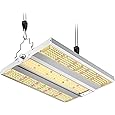
VIPARSPECTRA Upgraded P4000 LED Grow Lights Dimmable Full Spectrum Commercial Grow Lamp
Category: Grow Lights
Check Current PriceVIPARSPECTRA Upgraded P4000 LED Grow Lights are probably the best fit for 5×3 flowering tents. They draw 450W and claim effective 5×3 bloom coverage. Grow Lights buyers gain a dimmable full-spectrum fixture for veg-to-flower cycles.
Why VIPARSPECTRA P4000 Excels in 5×3 Flowering Tents
VIPARSPECTRA Upgraded P4000 LED Grow Lights deliver balanced full-spectrum output and strong usable photons across a 5×3 flowering canopy. VIPARSPECTRA P4000 pairs dense white diodes with targeted red and IR to drive photosynthesis and flowering. This combination increases canopy penetration and supports compact, resinous bud formation under realistic tent layouts.
- Wattage: 450W draw (AC powered)
- Equivalent claim: 1000W HPS/MH (manufacturer claim)
- Flowering coverage: 5×3 ft; Vegetative coverage: 5×4 ft
- Spectrum: 3000K + 5000K whites, 660nm red, IR 730
- LED counts: 1272x 3000K, 632x 5000K, 52x 660nm red, 4x 730nm IR
- Dimming: knob (single-channel brightness control)
VIPARSPECTRA Grow Lights package these components into a fanless aluminum heat-sink design to reduce noise and dust intake. The P4000 Grow Lights offer plug-and-play mounting and a simple on-off switch for beginner-friendly installation. That compact user flow speeds setup inside a tent and reduces rookie mistakes under tight 5×3 footprints.
How do spectrum and diode choices boost bud growth in 5×3 tents?
P4000 increases bud density and enhances resin production. The mix of warm 3000K and cool 5000K whites supplies broad-spectrum photons that support both photosynthesis and plant morphology. Targeted 660nm red diodes stimulate flowering pathways and increase flower size, while 730nm IR shifts phytochrome balance to improve stretch and canopy penetration. PAR (Photosynthetically Active Radiation) refers to 400-700nm light that plants use for photosynthesis; higher usable photons within this band improve yields when delivered evenly across the canopy.
Optimizing Light Distribution and PAR Coverage in 5×3 Tents
VIPARSPECTRA Upgraded P4000 LED Grow Lights produce a tight but even footprint when you position and dim correctly inside a 5×3 tent. The fixture s dense LED array emphasizes center output so you must manage height and dimming to flatten PAR across a rectangular canopy. Proper placement reduces hotspotting and edge light falloff that lower overall harvest uniformity.
- Recommended starting hang height: 24-30 inches above canopy for full-power bloom
- Recommended dimming: 60-80 at 24-30 inches to reduce hotspots and improve uniformity
- Alternate hang for late flower: 16-20 inches with 50-65 dimmer to increase intensity safely
P4000 Grow Lights work best with a single centered fixture in a 5×3 tent for moderate plant counts like 6-12 medium plants. You can shift the light toward heavier canopy areas or use supplemental strips along tent sides to even PAR distribution. Measuring with a PAR meter every 10-15 inches over the canopy helps you tune height and dimmer to hit target PPFD values for flowering.
What mounting height and angle give even PAR across a 5×3 canopy?
VIPARSPECTRA P4000 produces most even PAR when hung 24-30 inches high at moderate dimming. At that height the light cone flattens to cover the rectangular space and reduces center hotspots. Angle adjustments are unnecessary for a centralized single-fixture setup; minor tilt toward canopy edges helps only when your tent has tall plants against one wall. For consistent PPFD, scan grid points across the canopy and adjust height or add side lighting until variation falls under 20 .
VIPARSPECTRA P4000 Reliability
VIPARSPECTRA Upgraded P4000 LED Grow Lights use passive cooling with aluminum heat sinks to increase component longevity. The silent fanless design removes moving parts that commonly fail and reduces dust intake inside tents. Many users report stable output and fewer maintenance tasks compared with active-fan fixtures, improving reliability across grow cycles.
P4000 Grow Lights ship with basic plug-and-play mounting and a dimmer knob that simplifies operation for first-time growers. The manufacturer lists US local after-sales customer support, which helps with troubleshooting and spare parts queries. Buyers should note the product listing omits explicit lifetime hours, warranty length, and PAR maps, so expect to validate performance personally with a PAR meter and thermometer.
How can I manage heat and airflow to prevent heat stress in 5×3 tents?
VIPARSPECTRA P4000 reduces heat buildup compared with active-fan LEDs but still requires tent ventilation. Position an inline exhaust fan at tent top to remove warm air and intake passive vents low to draw fresh cool air. Use oscillating clip fans for canopy-level airflow to strengthen stems and prevent microclimates that trigger heat stress. Monitor canopy temperature and leaf edges; keep canopy temperatures below 86 F (30 C) during lights-on to avoid heat-induced terpene loss.
Heat and Energy Use in 5×3 Grow
VIPARSPECTRA Upgraded P4000 LED Grow Lights draw 450W and therefore reduce energy compared with a 1000W HPS system in similar light-output claims. The lower wattage cuts electrical demand and reduces HVAC load in small rooms, which helps control overall operating expense. actual energy savings depend on local electricity rates and runtime per crop cycle.
P4000 Grow Lights combine passive cooling and efficient diodes to limit heat output per photon, which lowers required exhaust horsepower. At 450W continuous draw, plan for roughly 0.45 kW h usage per hour; multiply by your daily light hours to estimate cost. For example, running 12 hours daily costs approximately 0.45 kW h 12 h local rate; this calculation helps compare real operating costs versus HPS alternatives.
Buyers should weigh purchase price of $256.49 USD against claimed yield parity with 1000W HPS setups and reduced ongoing electricity and ventilation expenses. The P4000 model works well when paired with accurate PAR measurements, good tent airflow, and staged dimming across growth phases. That combination produces reliable harvests for growers using 5×3 tents with moderate plant densities.
Follow-up question: How many plants should I run under the P4000 in a 5×3 tent? Most growers run 6-12 medium plants; use training (SCROG or topping) to maximize canopy uniformity. Follow-up question: Do I need additional side lighting? Add LED strips or smaller panels only if PAR drops more than 20 from center to edge; a PAR meter will confirm need. Follow-up question: How long before I see ROI? Expect returns after several harvests; savings depend on yield stability, electricity cost, and how closely you match HPS yields.