
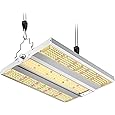
VIPARSPECTRA Upgraded P4000 LED Grow Lights Dimmable Full Spectrum Commercial Grow Lamp
Category: Grow Lights
Check Current PricePick VIPARSPECTRA Upgraded P4000 for balanced veg-to-flower, Mars Hydro FC-E4700 for bloom ROI. The P4000 uses 450W and a passive full-spectrum array. These Grow Lights suit 5×3 to 5×4 foot tents.
Comparing VIPARSPECTRA P4000 light spectrum and output characteristics
The VIPARSPECTRA Upgraded P4000 Grow Lights provide a full-spectrum blend with heavy white and red peaks, suited for all stages. The unit draws 450W and the vendor claims equivalence to a 1000W HPS fixture, which impacts perceived output. The manufacturer lists dense counts of warm and cool white LEDs plus discrete red and IR for spectral tuning. Growers must judge the lack of published PAR maps by measuring actual PPFD at canopy with a quantum sensor before trusting vendor equivalence claims.
Key reported specifications for the VIPARSPECTRA P4000
- Wattage: 450W draw (AC powered)
- Vendor claim: equivalent to 1000W HPS/MH
- Coverage: Vegetative 5×4 ft; Flowering 5×3 ft
- Spectrum: 3000K + 5000K whites, 660nm red, IR 730
- LED counts: 1272 3000K, 632 5000K, 52 660nm red, 4 IR730
- Dimming: knob for whole unit
- Cooling: passive fanless with aluminum heat sinks
How do spectrum and PAR differences influence bud development?
VIPARSPECTRA P4000 produces a broad white and red mix that supports both foliage and flower chemistry. PAR (photosynthetically active radiation) measures usable 400-700nm photons that plants use; PPFD (photosynthetic photon flux density) measures those photons per square meter per second. Higher red fraction and targeted PPFD during bloom typically encourage thicker calyx formation and increased terpene profiles in many crops. Growers should prioritize measured PPFD over vendor claims and adjust photoperiod and nutrient levels to match the delivered spectrum.
Assessing energy efficiency, heat and coverage for indoor grow tents
The VIPARSPECTRA Upgraded P4000 balances a 450W draw with passive cooling, making it energy-lean for its claimed output. The fanless heatsink design lowers noise and moving-part failure risk, but the unit still releases heat into a tent environment. Claimed coverage fits common tents; growers must map PPFD at 12-18 inch heights to confirm usable footprint. The unit s dimmer knob lets tent growers reduce wattage to manage canopy heat and electrical cost during sensitive stages.
What mounting height and footprint optimize heat and canopy coverage?
VIPARSPECTRA P4000 delivers optimal canopy PPFD at commonly recommended hanging heights. Seedlings usually start at 24-30 inches to avoid light stress, vegetative stages work well at 18-24 inches, and bloom often requires 12-18 inches for strong PPFD. Tent users should measure with a quantum PAR meter at multiple canopy points to build a PPFD map and avoid hot spots. Adjust the dimmer downward if canopy edges exceed species-specific PPFD targets to reduce heat load and electricity use.
Choosing Mars Hydro FC-E4700 for flowering yields and ROI analysis
VIPARSPECTRA Upgraded P4000 suits flexible multi-stage grows, while Mars Hydro FC-E4700 targets high-PPFD bloom rooms and yield optimization. The P4000 s passive cooling and dimmer make it easier for first-time installers to manage heat and power. Buyers evaluating either option should prioritize measured PAR/PPFD, spectral composition, fixture efficacy, warranty terms, and local electricity costs before purchase.
When does higher PPFD translate into measurable ROI for a small farm?
Mars Hydro FC-E4700 produces higher bloom PPFD that can increase grams per square meter under optimal conditions. Increased PPFD raises photosynthetic rate until plants reach a saturation point where returns diminish, so more light only improves yield when CO2, nutrients, and root health are not limiting factors. Example economics: an extra 200W per fixture running 12 hours equals 2.4 kWh daily; at $0.12/kWh that adds about $0.29 per day per fixture. Small farms should calculate incremental revenue per cycle from extra yield, subtract added electricity and HVAC costs, and then divide by fixture cost to estimate payback months.
Follow-up searches readers will ask next and quick answers
- How do I measure PPFD at the canopy? Use a quantum PAR meter (measures mol m s ) and sample a 3 3 grid across canopy.
- Can I run P4000 and FC-E4700 together? Yes, but match flowering PPFD targets and control drivers together to avoid spectral or intensity mismatch.
- What warranty and service differences matter? Favor fixtures with explicit warranty periods, local service, and published lifetime and efficacy data.
Practical buyer tips: match fixture coverage to tent size, budget for a reliable PAR meter, and test vendor claims with measurements. Consider electricity rates, HVAC capacity, and crop value before choosing high-PPFD fixtures. Finally, compare local after-sales support and real-world user PAR maps to ensure predictable canopy results.