
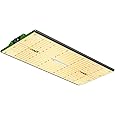
Buy the VIPARSPECTRA XS3000 Pro 300W LED Grow Light for the best value and uniform output. It matches full-spectrum output and daisy-chain dimming for commercial setups. These Grow Lights suit 4×4 and small commercial tents.
Comparing VIPARSPECTRA XS3000 Pro and Mars Hydro TS 3000 performance
The comparison favors optics, spectrum, and control more than raw wattage when choosing equipment for cultivation. The XS3000 Pro Grow Light uses optical lenses and an aluminum heatsink to deliver a uniform PPFD pattern across canopy edges. Mars Hydro TS 3000 typically favors wide-distribution diodes and a flatter price point, which benefits budget-conscious growers. Choosing between the two depends on whether you prioritize even light (corner-to-corner) or upfront cost savings.
Key technical specifications that affect canopy light delivery
- VIPARSPECTRA XS3000 Pro: 300W actual power draw, full spectrum (3000K, 5000K, 660nm, 730nm IR)
- XS3000 Pro coverage claims: Vegetative 4×3 ft, Flowering 4×2 ft; recommended two units for 4×4 ft tent
- Dimming and control: 6-level dimming knob with daisy-chain up to 20 units (XS3000 Pro)
How do PAR, PPF and light spectrum translate to yields?
VIPARSPECTRA Grow Light delivers higher usable PAR at canopy corners and mid-canopy by concentrating photons. Higher photosynthetic photon flux (PPF) increases potential yield when plants use light efficiently; PPF (measure) equals total photons per second. Spectrum balance matters because 3000K and 5000K drive vegetative growth, and 660nm plus 730nm enhance flowering and photomorphogenesis. In practical terms, more uniform PPFD and a complete spectrum improve bud set and stretch control, which boosts harvest weight per square foot.
Power draw, heat output, and efficiency for 3000W LED fixtures
When discussing fixtures in the 300W class, focus on actual wattage, thermal design, and claimed equivalence to HPS bulbs. The XS3000 Pro draws about 300W from mains and advertises replacement for a 500W HPS/MH while lowering energy use. Mars Hydro TS 3000 similarly targets the 300W class with full-spectrum LEDs; manufacturers sometimes quote horticultural equivalence instead of raw efficacy numbers. For any 300W-class Grow Lights, cooling strategy and driver efficiency determine how much heat reaches the canopy and how much light converts to usable PAR.
Practical thermal and electrical differences to check before buying
- Power draw: Verify manufacturer-rated actual watts, not nominal fixture nameplate
- Cooling: Look for active heatsinks, aluminum bodies, or fans to reduce canopy heat
- Efficiency: Seek measured PPF/W if available to compare photon output per electrical watt
What are real electricity costs and heat management needs?
XS3000 Pro reduces electrical load compared with a 500W HPS equivalent, lowering runtime costs. Average electricity cost depends on local rates; at $0.15/kWh a 300W fixture running 12 hours daily costs about $1.62 per day. Heat output requires either passive dissipation or inline exhaust; aluminum heatsinks on this VIPARSPECTRA XS3000 Pro LED grow light lower housing temperatures more effectively. For outdoor or tent setups, match exhaust CFM to the heat load to avoid canopy temperature spikes and stomatal stress.
Choosing VIPARSPECTRA XS3000 Pro vs Mars Hydro TS 3000 for growers
For most first-time buyers who want predictable, uniform canopy light, XS3000 Pro is the safer long-term choice. The reviewed VIPARSPECTRA XS3000 Pro LED grow light pairs optical lenses and unified dimming, which simplify scaling to multiple fixtures. Conversely, the Mars Hydro TS 3000 appeals to buyers prioritizing initial cost and straightforward white-LED arrays over lens-driven uniformity. Your choice should reflect your space, budget, and whether you plan to expand into multi-light runs.
Which unit gives better ROI across different grow scenarios?
XS3000 Pro yields faster ROI in dense canopy runs due to higher usable PPFD and daisy-chain control. In a single four-by-four tent, two XS3000 Pro units provide controllable intensity and likely boost flower uniformity compared with similarly priced alternatives. For low-budget, single-plant grows, the TS 3000 option may return quicker due to lower upfront cost despite slightly lower photon uniformity. Evaluate ROI by estimating expected grams per watt, local electricity cost, and replacement cycle for drivers or diodes.
Practical buying tips: match fixture coverage to tent size, prefer measured PPF/W data, and buy from dealers offering clear return policies. Consider mounting height, recommended number of fixtures, and whether you need daisy-chain dimming for unified control in larger rooms. Check local regulations for outdoor Grow Lights to ensure compliance with light trespass and electrical codes.
Follow-up questions growers often ask include: Which fixture needs less ventilation? What dimming level suits seedlings? How many fixtures for a 4×4 tent? For ventilation, units with aluminum heatsinks like the XS3000 Pro require less forced airflow than fan-cooled fixtures. For seedlings, start at 20-40 intensity and increase gradually to avoid photobleaching. For a 4×4 tent, two XS3000 Pro fixtures typically deliver even coverage when spaced per manufacturer recommendations.