
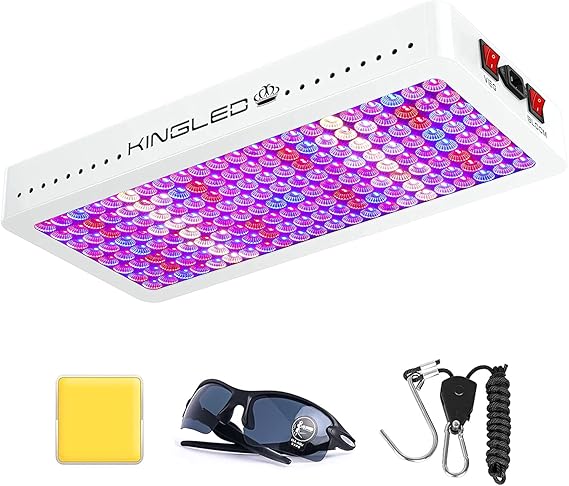
KingLED Newest 2000W LED Grow Light with LM301B LEDs and 10x Optical Condenser 5×5 ft Full Spectrum Indoor Hydroponic Grow Light
Category: Grow Lights
Check Current PriceChoose KingLED Newest 2000W LED Grow Light with LM301B LEDs for efficient 5×5 vegetative coverage. It draws 275W and uses LM301B chips at 2.8 umol/J efficacy. This unit ranks among modern Grow Lights for indoor hydroponic setups.
When to Choose KingLED 2000W LM301B for Vegetative Growth
Pick KingLED Newest 2000W LED Grow Light with LM301B for strong vegetative PAR across 5×5 Grow Lights setups. PPFD (photosynthetic photon flux density) measures photons per square meter per second and indicates usable plant light. Aim for 200-400 mol/m /s PPFD during vegetative growth; seedlings thrive near 100-250 mol/m /s.
- LED chip: LM301B (high-efficiency SMD)
- Power draw: 275W (actual measured load)
- Efficacy: 2.8 mol/J (photons produced per joule)
- Vegetative coverage: rated 5×5 ft
- Flowering coverage: rated 4.5×4.5 ft
After initial light placement, the reviewed KingLED LM301B needs vertical adjustment to hit target PPFD bands. Use a quantum PAR meter or smartphone apps with calibrated sensors to measure PPFD every week. Keeping light intensity steady reduces stretch and improves node development for vegetative plants.
How much PPFD and spectrum are ideal for young seedlings?
The reviewed KingLED LM301B produces 120-250 mol/m /s at typical seedling heights for gentle growth. For delicate seedlings, use the spectrum’s lower blue-weighted output and avoid full intensity to prevent photobleaching. Blue light (short wavelengths) encourages compact growth, while red light (long wavelengths) drives stem elongation and flowering transition. Start seedlings at roughly 100-150 mol/m /s and ramp intensity by 50 mol/m /s per week until veg targets. This gradual ramp reduces shock and mimics natural sun increase.
Evaluating spectrum, PPFD and canopy coverage in closets
Pick KingLED Newest 2000W LED Grow Light with LM301B when you need full-spectrum output inside compact closets or cabinets. The lamp uses a 12-wavelength full spectrum and 10x optical condenser to concentrate photons for deeper canopy penetration. In tight spaces, controlled spectrum (veg vs bloom mode) and concentrated optics reduce wasted light and wall reflections.
- Spectrum: full spectrum (12 wavelengths) with veg and bloom modes
- Optical condenser: 10x for focused light distribution
- Cooling: multiple high-speed mute fans with upgraded aluminum radiator
When you mount this KingLED 2000W LM301B in a closet, expect sharper hot spots near the center and lower PPFD at edges without reflectivity improvements. Add internal mylar or flat white paint to increase usable canopy PPFD by 10-25 percent. Also measure at canopy height across a 2×4 footprint to decide whether you need a second unit or a reflector upgrade.
Can I achieve uniform canopy PPFD in a 2×4 grow tent?
This KingLED LED Grow Lights design produces a center-heavy PPFD map but can reach usable uniformity in small tents with adjustments. Raise the fixture and use a modest hanging height to flatten the PPFD gradient while keeping peak values within 20-30 percent of average. Add a small clip fan to mix air and reduce microclimates that exaggerate light differences. For best results in a 2×4 tent, place the lamp centered and supplement corners with 15-30W white LEDs or reflective liners. Those steps produce near-uniform canopy light and reduce yield variation across the tent.
Choosing KingLED 2000W LM301B for energy-efficient flowering
Pick KingLED Newest 2000W LED Grow Light with LM301B to maximize photon output per watt during bloom cycles in a 4×4 canopy. The unit claims an equivalent to 1000W HPS while drawing 275W, so it lowers electrical load compared with legacy HID systems. Flowering benefits from the lamp’s red-weighted bloom mode and sustained PPFD in the 600-900 mol/m /s flowering band when properly hung close to canopy.
- Marketed wattage: 2000W equivalent to 1000W HPS/MH
- Power draw: 275W actual consumption
- Efficacy: 2.8 mol/J allowing higher PPFD per watt
- Flower coverage claim: 4.5×4.5 ft
Switching to the reviewed KingLED LM301B for bloom saves electricity and reduces HVAC load compared with 1000W HPS rigs. To reach high flower PPFD, lower the light to recommended hang height and monitor leaf tips for bleaching. Expect denser buds with targeted spectra and consistent PPFD control.
What electricity costs and heat output will a 4×4 canopy incur?
This KingLED 2000W LM301B uses 275W and produces about 0.275 kWh per hour of electrical energy. Running 12 hours per day yields 3.3 kWh daily and roughly 99 kWh monthly; at $0.13/kWh that equals about $12.87 per month. Compared to a 1000W HPS using 1.0 kW, the LED saves approximately 8.25 kWh daily and cuts monthly electricity by about $28.50. Heat output equals electrical input minus photon energy; expect less ambient heat than equivalent HID setups, but still plan ventilation for continuous 275W heat dissipation.
Practical follow-up questions buyers search next
Can I dim or timer this unit and what control do I need? The unit lacks specified dimming controls, so use a recommended inline timer or external dimmer rated for LED drivers. Do I need extra venting or active cooling? Yes, even efficient LEDs require exhaust or inline fans to remove the 275W thermal load and keep canopy near the recommended 50-60 F operating envelope. How does LM301B compare to LM301H for flowering? LM301B (efficiency-focused) delivers excellent photon-per-watt; LM301H often targets higher red output for bloom choose based on your spectrum priorities.
Possible next searches: “How high should I hang KingLED 2000W LM301B for flowering?” and “Do I need a second KingLED for full 5×5 uniformity?” Hang heights vary by target PPFD and plant stage; measure PPFD to decide. A second unit improves uniformity and boosts average canopy PPFD by roughly 40-60 percent depending on spacing.