
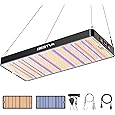
Choose the KINGLED KP4000 LED Grow Lights for 4×4 to 5×5 foot grow spaces. It delivers 400W, 2304 LEDs, and high PPFD close to plants. These Grow Lights suit indoor hydroponics and small greenhouse setups.
When to Choose KINGLED KP4000 for Small Greenhouses
Choose KINGLED KP4000 when you need compact, high-output Grow Lights for small greenhouse benches and racks. The KP4000 provides a full-spectrum lamp with concentrated PAR output suited to 4×4 and 5×5 areas, and it reduces energy versus older high-pressure sodium (HPS) fixtures. Users get three modes (Veg, Bloom, Veg&Bloom), quiet fans, and a 3-year professional service plan that supports small-scale greenhouse projects. Practical buyers love the unit for bench rows, propagation shelves, and compact multi-tier racks where a single lamp must serve multiple plants evenly.
Key product specifications that determine greenhouse fit
- Power draw: 400W (AC100-240V)
- LED count: 2304 (Red 256, Blue 256, White 896, Yellow 896)
- PPFD: 2350 mol/s at 6 inches
- Spectrum: 460 nm (blue); 3000K-5000K (white); 660 nm (red)
- Cooling: aluminum heat sink, metal housing, high-speed mute fans
What greenhouse or tent sizes suit a single LED unit?
KP4000 covers 4×4 to 5×5 foot tents effectively. For a 4×4 grow tent, hang the unit 12-18 inches above canopy to balance PPFD and uniformity. For a 5×5 footprint, raise the fixture to 18-24 inches to spread light more evenly across the canopy and reduce hot spots. These hanging-height rules reduce localized PPFD peaks (which can stress plants) while keeping average PPFD in target ranges for veg and bloom stages.
Choosing right light output for small greenhouse and tent
Evaluate required light output by target PPFD and crop type when sizing Grow Lights for tents and micro-greenhouses. The KP4000 s high short-distance PPFD (2350 mol/s at 6 inches) means you must adjust mounting height to reach desired canopy PAR (photosynthetically active radiation). PAR (light useful for photosynthesis) matters because plants respond to photon flux, not lumens; PPFD (photosynthetic photon flux density) measures photons per square meter per second. Match PPFD targets to growth stages: seedlings need 100-300 mol/m /s, vegetative growth 300-600 mol/m /s, and flowering 600-900+ mol/m /s depending on crop intensity.
Recommended PPFD ranges for common small-greenhouse crops
- Leafy greens (lettuce, basil): 150-300 mol/m /s
- Bush tomatoes, peppers during bloom: 600-900 mol/m /s
- High-light crops (tomato, cucumber, cannabis): 800-1200 mol/m /s
How should I assess heat load and ventilation needs?
KP4000 produces moderate heat but includes active cooling to manage case temperature. Convert electrical heat to BTU to size ventilation: 400W 3.412 = 1,365 BTU/hour, which is the heat the tent will need to remove. For a 4×4 tent, plan for an exhaust fan in the 150-250 CFM (cubic feet per minute) range with a matched intake; for 5×5 tents, use 250-400 CFM depending on additional heat sources. Select inline fans from AC Infinity or VIVOSUN and use oscillating clip fans for canopy airflow to prevent hot spots and reduce relative humidity.
Assessing KINGLED KP4000 versus HID for small tents
Compare KP4000 LED performance to HID by looking at wattage, spectrum, and ventilation needs to decide which suits a small tent. The KP4000 draws 400W and gives a full spectrum (460nm blue, 660nm red plus broad white) that supports both vegetative and flowering stages without changing lamps. By contrast, a common 600W HPS (high-pressure sodium) lamp draws more power and emits a warmer red-biased spectrum that typically requires separate MH (metal halide) for veg, adding complexity. LEDs reduce ballast heat and often yield energy savings; moving from a 600W HPS to a 400W LED typically cuts electrical use by roughly 33 while keeping or improving canopy PAR distribution when properly hung.
Which crops and growth stages gain most from LED swaps?
KINGLED LED Grow Lights improve flowering yield for high-light crops when properly managed. Growers switching from HPS to this KP4000 often see stronger canopy color and comparable or better flowering because of targeted 660 nm red and 460 nm blue bands that drive flowering and compact vegetative growth. Leafy greens and microgreens gain from the tunable veg mode that emphasizes blue light for compact, dense leaves, while fruiting crops like tomatoes and peppers benefit from the higher red content during bloom. Note limitations: the product omits explicit efficacy ( mol/J) and a PPFD map, so buyers should hang at recommended heights and verify canopy PPFD with a PAR meter for precise results.
Follow-up question: How high should I hang the KP4000 in a 4×4 tent? Hang 12-18 inches above canopy for balanced PAR and uniformity, and raise incrementally if leaf edges show bleaching. Follow-up question: Can I replace a 600W HPS with this LED without redoing ventilation? You can often swap to the KP4000 and reduce ventilation needs slightly, but calculate based on 1,365 BTU/h heat and maintain adequate CFM to control temperature. Follow-up question: What missing data should I ask the seller before buying? Ask for efficacy ( mol/J), a PPFD map at different heights, fixture dimensions, and mounting hardware to ensure proper tent fit and expected energy performance.