
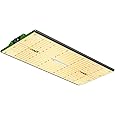
Choose the VIPARSPECTRA XS3000 Pro 300W LED Grow Light for energy-efficient flowering in small tents. It replaces 500W HPS while drawing 300W and offering full-spectrum output. This guide addresses Grow Lights practical choices and PPFD (photosynthetic photon flux density).
Choosing the VIPARSPECTRA XS3000 Pro for energy-efficient flowering
The VIPARSPECTRA XS3000 Pro 300W LED Grow Light suits growers who want efficient bloom light with even canopy coverage. VIPARSPECTRA XS3000 Pro replaces a 500W HPS while drawing 300W and uses optical lenses to reduce hot spots. Relevant specifications include:
- Wattage: 300W average power draw
- Spectrum: full spectrum (3000K, 5000K, 660nm red, 730nm IR)
- Coverage: vegetative 4×3 ft, flowering 4×2 ft (manufacturer recommendation)
- Dimming: 6-level dimming knob with daisy-chain support up to 20 units
- Optics: optical lens design for more uniform PPFD
XS3000 Pro Grow Light produces uniform PPFD (usable photons per second across canopy) so plants receive consistent usable light. The optical lens design spreads PAR (photosynthetically active radiation) across corners rather than concentrating in the center. This even distribution reduces required fixture count and lowers energy per usable photon, improving flower set and yield consistency.
How do power draw and PAR efficiency affect flowering choice?
VIPARSPECTRA Grow Light reduces electricity per flowering cycle compared with 500W HPS by running 300W instead. PAR (photosynthetically active radiation) measures usable photons from 400-700 nm that drive photosynthesis, and PPFD quantifies those photons per square meter per second. When a fixture converts electrical watts into higher PPFD at canopy level, it lowers kWh required per gram of harvest. Because the XS3000 Pro advertises uniform PPFD and full spectrum, growers prioritizing energy-per-yield and uniform canopy light should favor lenses and dimming offers.
Assessing canopy size and run costs for efficient flowering
The VIPARSPECTRA XS3000 Pro 300W LED Grow Light is best sized by matching its 4×2 ft flowering footprint to your canopy layout. Manufacturer guidance recommends two units for a 4×4 ft tent to avoid edge shading and maintain even bud development. Estimate run costs using local electricity rates to know real operational expense and ROI. Practical cost planning avoids surprises during long flowering cycles.
Use the following example when estimating monthly power costs at a common U.S. rate of $0.13 per kWh and a 12-hour flowering photoperiod:
- Single unit daily energy: 300W 12 hours = 3.6 kWh/day
- Single unit monthly energy: 3.6 kWh/day 30 days = 108 kWh/month
- Single unit monthly cost: 108 kWh $0.13 = $14.04 per month
VIPARSPECTRA XS3000 Pro scaling via daisy-chain dimming lets you lower draw during early bloom and seedlings to shrink those costs. Dimming reduces electrical current to LEDs and therefore lowers kWh roughly proportional to dimming percentage, so using 60 power reduces monthly cost close to 60 of full-power cost.
What are the ideal tent sizes and dimming for bloom efficiency?
XS3000 Pro Grow Light maximizes a 4×4 ft tent bloom when two units run and dimming balances PPFD across the canopy. Set dimming higher during late bloom to push flower development, for example 90-100 in final 2-3 weeks, and lower during early bloom and veg at 40-70 to reduce stretch and save energy. The unit s 6-level dimming knob (which controls LED current) and daisy-chain unified dimming simplify matching PPFD across multiple fixtures. For small tents under 3×3 ft, run a single unit at reduced height and 60-80 to avoid light saturation and heat stress near the canopy.
When the VIPARSPECTRA XS3000 Pro outperforms LEDs on energy per yield
The VIPARSPECTRA XS3000 Pro 300W LED Grow Light outperforms many budget fixtures when you need uniform canopy PPFD and HPS replacement efficiency. This model advertises replacing a 500W HPS while drawing 300W, and growers who formerly used 500W high-pressure sodium lamps often see lower electrical bills after switching. The optical lens design and full-spectrum blend favor even bud set where fixture placement is constrained, making the fixture more yield-efficient in tight canopies. the product lacks detailed PPF output and warranty terms, so precise energy-per-gram claims require grower testing.
When is lower wattage and spectrum balance preferable for yields?
The reviewed VIPARSPECTRA XS3000 Pro LED grow light increases harvest quality when you match spectrum to plant stage and avoid excessive wattage near foliage. Use the unit s spectrum strategically: 5000K leans vegetative and promotes leaf expansion, 3000K favors flower development with warmer tones, 660nm red stimulates flowering, and 730nm IR encourages stretch and phytochrome responses. Run lower wattage or reduce dimmer settings when canopy distance is under 12 inches to prevent bleaching and heat stress, and ramp to higher settings during peak flower. Note the XS3000 Pro lacks published PPF or warranty details, so growers should test light schedule, dim settings, and spacing before scaling commercially; the fixture performs best when optical uniformity and daisy-chain control match your canopy strategy.
Possible follow-up questions growers search next include: How many XS3000 Pro units fit a 5×5 ft tent? Answer: start with two units, then measure PPFD and add a third if edges read below target PPFD. Another question: What dimming schedule yields best bud density? Answer: use 60-80 during stretch, 80-100 for ripening, and drop power for seedlings to save energy while avoiding light stress.