
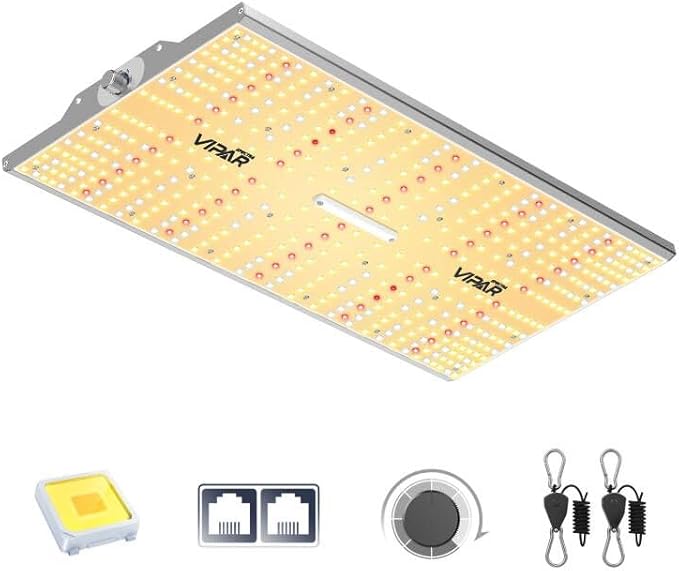
VIPARSPECTRA XS2500 250W Dimmable LED Grow Light for Seed Starting
Category: Grow Lights
Check Current PriceChoose HLG 260R for flowering efficiency, or VIPARSPECTRA XS2500 250W Dimmable LED Grow Light. HLG favors red-heavy output while the XS2500 provides a broad Samsung LM301H spectrum. Both Grow Lights suit indoor growers and greenhouse hobbyists.
Comparing VIPARSPECTRA XS2500 and HLG 260R performance
Performance differs between the units; HLG aims for higher PAR per watt outputs. VIPARSPECTRA XS2500 focuses on balanced spectrum and wider even distribution across canopy. VIPARSPECTRA Grow Lights use Samsung LM301H diodes and passive cooling. XS2500 LED Grow Light yields good depth and even PAR hitting lower leaves.
XS2500 key technical details and manufacturer claims
- Average power draw: 250W (manufacturer specification)
- Diode type: Samsung LM301H (high-efficiency white LED)
- Spectrum: 3000K, 5000K, 660nm red, 730nm IR (full-spectrum plus far-red)
- Dimming: 7-level knob; daisy-chain up to 20 units (practical for multi-fixture runs)
How do spectrum differences and PAR output affect flowering?
HLG 260R delivers stronger red and deep-red photons improving bud density. PAR (photosynthetically active radiation) measures useful light; red photons drive flowering efficiency. XS2500 supplies balanced white plus 660nm and 730nm to support canopy and finish stages. Practically, choose the red-heavy fixture for late flowering and the balanced lamp for uniform growth.
Power draw, heat, and coverage differences for indoor growers
Power draw and heat differ; Grow Lights choice affects canopy footprint and temperature control. VIPARSPECTRA Dimmable LED grow light for indoor seed starting draws 250W and uses passive cooling. HLG units generally advertise higher efficacy, so they can use less wattage for similar PAR. This XS2500 LED grow light lists flowering coverage near 4x2ft and veg at 4x3ft for practical beds.
Practical power and coverage figures to compare
- XS2500 average draw: 250W (use for electricity cost estimates)
- Recommended coverage (manufacturer): Vegetative 4×3 ft, Flowering 4×2 ft
- Cooling: passive aluminum heat sinks (no fan noise; keep airflow clear)
Can efficiency and electricity costs change my ROI timeline?
HLG 260R improves photons-per-watt, lowering electricity per gram and shortening ROI. VIPARSPECTRA Grow Lights cost less upfront, which can lengthen payback if efficiency lags. Estimate ROI by comparing wattage, lumens, and expected yield over typical 12-week cycles. Higher local electricity (per kWh) magnifies savings from more efficient fixtures quickly.
Choosing between VIPARSPECTRA XS2500 and HLG 260R for growers
Selection depends on needs; Grow Lights buyers focused on budget arrays often prefer XS2500 LED Grow Light. The reviewed VIPARSPECTRA XS2500 grow light offers plug-and-play setup and daisy-chain for larger runs. HLG 260R suits growers who need optimized flowering spectra and maximal PAR efficiency per square foot. Practical tip: match fixture choice to room size, number of fixtures, and local electricity rates.
Maintenance checklist and warranty points to verify before buying
- Dust heat sinks weekly in dusty rooms to maintain thermal performance
- Confirm driver model (Mean Well or equivalent) and input voltage compatibility
- Ask retailer for written RMA policy and LED lumen/PPF degradation warranty details
What maintenance and warranty scenarios should I consider?
VIPARSPECTRA XS2500 provides US-based after-sales service but lacks published warranty terms. Expect simple maintenance: dust heat sinks, verify driver connections, and keep ventilation clear. For HLG units, check Mean Well driver models and confirm input voltage compatibility with your grid. Q: Can these operate outdoors? A: No; they are built for indoor and greenhouse use. Q: How fast is ROI? A: Often within one to three harvests depending on electricity and yield.