
Most residential and commercial installations require a monocrystalline solar panel efficiency between 20% and 22%. While higher percentages exist, these figures represent the point where the most significant gains in power density occur for standard mounting surfaces.
Recommended Efficiency Values for Monocrystalline Solar Panels
| Use Case | Recommended Efficiency | Why This Number |
|---|---|---|
| Residential Rooftops | 20% – 22% | Balances cost per watt with the need to maximize limited surface area. |
| Commercial Solar Farms | 18% – 20% | Lower efficiency is acceptable when large land areas allow for more total panels. |
| Small Space / RV Power | 22% + | High-density cells are necessary when every square inch of mounting space is critical. |
| Off-Grid Systems | 20% – 22% | Provides a reliable power-to-weight ratio for mobile or remote setups. |
Where these choices show up in our reviews
From $119 to $520.23: the 3 in this category we have reviewed in full.

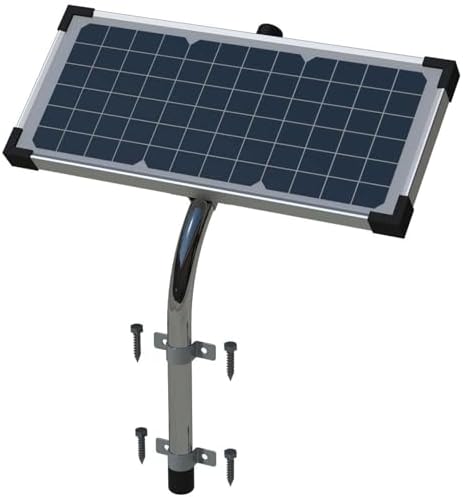

ACOPOWER 100w 12v Monocrystalline Solar Panel
$520.23 price checked August 2026
Read our full ACOPOWER 100w Solar Panel review
If your installation requires a curved surface, view our top-rated flexible monocrystalline solar panel options to see the best performance.
What Happens if You Under-Provision or Over-Buy Efficiency?
Under-provisioning occurs when you select a monocrystalline solar panel with an efficiency rating below 18% for a space-constrained project. Because lower efficiency means each individual cell produces less power, you must install more panels to meet your energy requirements. This increases the total weight of the array, the number of mounting brackets needed, and the complexity of the wiring and racking systems.
The Physical Costs of Lower Efficiency
If the available roof space is limited, a low-efficiency panel may make it impossible to reach your target kilowatt-hour output. You might find yourself forced to install a secondary array in a less-than-ideal location, such as a backyard or a shaded area, which reduces the overall performance of your system. Choosing a panel with a lower efficiency rating in a small space creates a physical bottleneck where the lack of surface area prevents you from meeting your power needs.
Over-buying efficiency involves purchasing high-end modules, such as those reaching 23% or higher, when your installation site has ample space. While these high-efficiency panels are technically superior, the price per watt often increases significantly as efficiency climbs toward the theoretical limits of silicon. If you have a large field or a massive roof, the extra cost of a 23% efficient panel provides no functional advantage over a 21% panel because you have enough space to simply install more of the standard units.
The Financial Cost of Over-Buying
The premium for high-efficiency technology is a real expense that does not translate into extra power if your land area is unlimited. For large-scale utility projects, the goal is the lowest cost per watt. Paying for the highest possible efficiency on a massive acreage is a waste of capital that could have been spent on more panels or better inverter technology. In these cases, the “best” panel is the one that meets the required output at the lowest cost, not the one with the highest percentage on the spec sheet.
The Efficiency Mistake and What to Optimize Instead
The most common mistake buyers make is assuming that a higher efficiency percentage automatically results in a better return on investment. Efficiency is a measure of how much of the sun‘s energy the panel can convert into electricity, but it does not account for the total energy yield of the system over a year.
Prioritizing Total Yield over Peak Efficiency
You should optimize for total energy yield, which is influenced by factors like the temperature coefficient and the degradation rate. A panel with 21% efficiency that loses 0.5% of its output every year is a better long-term investment than a 22% panel that degrades by 1% annually. When you look at the data, the annual production of the system is what pays for the equipment, not the laboratory efficiency rating of the individual cell.
Another critical factor to optimize is the power output per square meter. While efficiency tells you the percentage of conversion, the actual wattage per square meter tells you how much power you can actually harvest. If two panels both have 21% efficiency but different surface areas, the one with the larger surface area will produce more power per unit. Always check the maximum power (Pmax) relative to the dimensions of the module to ensure you are getting the density you need for your specific layout.
How Efficiency Interacts with Other Deciding Specs
Efficiency interacts with the physical dimensions and the electrical standards of the system, often creating a ceiling on how useful a high efficiency rating can be. A very high-efficiency monocrystalline solar panel might be limited by the weight it can support or the voltage it can handle in a specific configuration.
Voltage and Current Limits
The efficiency of a panel is tied to its voltage (Vmp) and current (Imp) characteristics. If you choose a high-efficiency panel that produces a higher voltage than your charge controller or inverter can handle, the efficiency is wasted because the system will have to clip the power. You must ensure the electrical output of the panel matches the input requirements of your power electronics. A high-efficiency panel is only useful if your balance of system components can process the electricity it generates.
The Impact of Temperature Coefficients
High-efficiency cells can sometimes be more sensitive to heat, which affects their performance in hot climates. A panel with a high efficiency rating but a poor temperature coefficient will see its output drop significantly as the surface temperature rises during peak sunlight hours. When comparing options, look for a balance between a high efficiency percentage and a low temperature coefficient. This ensures that the panel maintains its efficiency during the hottest parts of the day when energy production is at its peak.
Long-Term Degradation and Efficiency
Efficiency is a snapshot of performance at the time of manufacture, but the degradation rate determines the efficiency of the panel in year ten or year twenty. High-end monocrystalline modules often feature N-Type TOPCon cells or similar technologies designed to maintain high efficiency over longer periods. When evaluating a high-efficiency choice, confirm the manufacturer’s stated degradation rate. A panel that stays at 95% of its original efficiency for two decades provides more value than a slightly more efficient panel that drops to 85% in the same timeframe.
Browse our other Monocrystalline Solar Panel pages
- Which High Efficiency Monocrystalline Solar Panel Is Best for Off Grid?
- Best Flexible Monocrystalline Solar Panels
- Monocrystalline Solar Panels for 12V Battery Systems Compared
- Choosing the Best Bifacial Monocrystalline Solar Panel for Maximum Yield
- The Slim Monocrystalline Solar Panels That Work Best for Trailers
- Which Monocrystalline Solar Panel Is Best for Home and Farm Use?