
The power output of a 100 Watt 12 Volt Flexible Monocrystalline Solar Panel is limited by environmental factors like temperature, shading, and cable length, meaning the 100W rating represents a laboratory maximum rather than a constant output.
While the Renogy 100 Watt 12 Volt Flexible Solar Panel is rated for 100W, actual yield varies based on peak sun hours and atmospheric conditions. For instance, overcast conditions or debris on the surface can cause significant power drops because flexible panels often use smaller cells where a single shadow can bottleneck the entire string. Because these panels have less airflow than rigid versions, surface temperature rises can also cause a sharp decline in output. We selected this model for our comparison because of its ETFE material and high light transmittance, which helps maintain efficiency compared to standard PET options. You must also account for voltage drop over your wire runs; long cables can reduce the usable wattage reaching your charge controller. Furthermore, you should check the specific “Maximum Power Voltage” (Vmp) and “Open Circuit Voltage” (Voc) in your manual to ensure they stay within your controller’s safety limits, especially in extreme cold where voltage can spike.
What to Check Before Buying the Renogy 100 Watt 12 Volt Flexible Solar Panel
Before purchasing this flexible solar panel, confirm these technical requirements to ensure your system functions correctly.
- Verify that your charge controller’s input range accommodates the Voc (Open Circuit Voltage) of the panel, especially in cold weather.
- Measure your cable run length to calculate potential power loss due to voltage drop over the wires.
- Confirm that your mounting surface is smooth enough for the 1/10th of an inch thickness to sit flush.
- Check the manufacturer’s support page for the specific Vmp (Maximum Power Voltage) to ensure compatibility with your 12V system.
- Identify potential shading points, such as mounting hardware or nearby trees, that could disproportionately tank the output of the small cells.
Power Output Considerations for Flexible Solar Panels
This flexible solar panel—a thin, bendable sheet that converts sunlight into electricity—serves users who need to power small electronics on curved surfaces like airstream roofs. While the Renogy 100 Watt 12 Volt Flexible Solar Panel offers a 70% weight reduction over conventional panels, it may not be the right choice for high-demand setups. If you require a high-wattage output for large battery banks or heavy appliances, you should look at rigid panels or larger arrays. Flexible panels are optimized for weight and surface conformity rather than maximum raw power density. For those needing to power a large RV house, a 100W capacity may be insufficient regardless of the panel’s efficiency.
If you are still narrowing down your options, see our top-rated flexible monocrystalline solar panel guide for a curated list of performers.
If you need a lightweight, thin solar solution for a curved surface or a mobile application where weight is a priority, the Renogy 100 Watt 12 Volt Flexible Solar Panel is a strong choice. However, if your application requires high-wattage output in a fixed location, you should consider a larger rigid panel system instead.
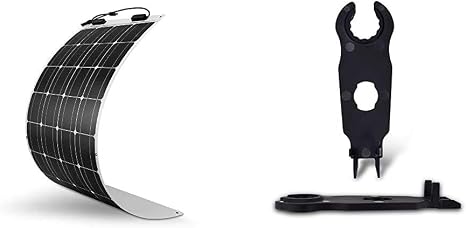
Renogy 100 Watt 12 Volt Flexible Solar Panel
For those seeking higher energy gains from both sides, view how to pick the best bifacial monocrystalline solar panel for your setup.
$186.98 price checked August 2026
The rest of our Monocrystalline Solar Panel guides
- Choosing the Best Bifacial Monocrystalline Solar Panel for Maximum Yield
- The Slim Monocrystalline Solar Panels That Work Best for Trailers
- Which Monocrystalline Solar Panel Is Best for Home and Farm Use?
- Choosing the Best Monocrystalline Solar Panel for RV and Boat
- The Monocrystalline Solar Panels That Work Best for Camping
- Which High Efficiency Monocrystalline Solar Panel Is Best for Off Grid?