
You need between 300W and 1,000W of power output for most indoor grow light applications depending on your canopy size. Selecting the correct wattage ensures your plants receive enough light to thrive without creating excessive heat or wasting energy.
Recommended Power Output for Grow Light Use Cases
| Use Case | Recommended Power Output | Why this number |
|---|---|---|
| Small Propagation Tray | 50W – 150W | Low intensity is sufficient for starting seeds and clones. |
| Desktop/Shelf Plant | 150W – 300W | Provides enough light for small pots without overheating small spaces. |
| Small Canopy (2x2ft) | 300W – 450W | Provides consistent coverage for small-scale hobbyist setups. |
| Medium Canopy (4x4ft) | 600W – 900W | Ensures high-intensity light reaches the center of the canopy. |
| Large Commercial Area | 1,000W+ per fixture | Necessary to achieve the PPFD required for large-scale fruit production. |
Grow Lights we have reviewed in detail
From $129.98 to $179.99: the 3 in this category we have reviewed in full.

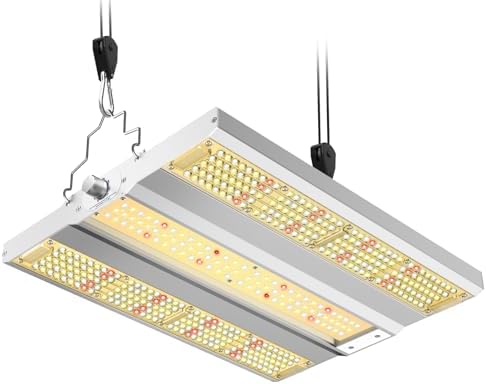
VIPARSPECTRA XS1500 Pro LED Grow Lights
If you are running a water-based setup, see our comparison of hydroponic lighting.
$129.98 price checked August 2026
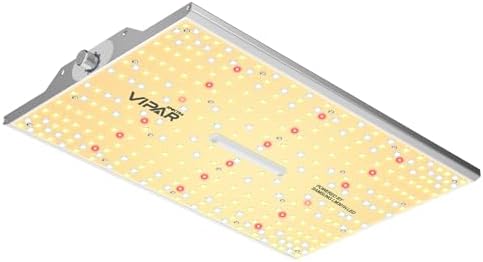
VIPARSPECTRA XS1500 LED Grow Light
$129.98 price checked August 2026
Read our full VIPARSPECTRA XS1500 review
For those starting from the beginning, explore top-rated options for nurturing seedlings.
What Happens if You Under-Provision or Over-Buy Power Output?
Under-provisioning occurs when the power output of a grow light is too low to meet the biological needs of the plant at its specific growth stage. If you provide less than the required wattage, plants often experience “stretching,” where they grow tall and spindly as they reach toward a light source that lacks sufficient intensity. This results in weak stems and poor fruit set because the plant cannot produce enough energy to support dense growth.
The Impact of Low PPFD on Growth
When power output is insufficient, the Photosynthetically Active Radiation (PAR) levels drop below the threshold required for flowering. This leads to morphological issues like poor fruit set or stunted development. If the light cannot provide enough energy to the canopy center, the plants will fail to thrive even if the surrounding areas are well-lit.
Over-buying power output involves installing a fixture with a wattage that exceeds the requirements of your space or the limits of the plant’s biology. While more power does not always equal better growth, it does create a significant thermal load. A 1,000W fixture in a space only designed for 400W will generate excessive heat, potentially leading to thermal throttling where the light dims to protect its components, or it may simply increase your electricity costs without providing any additional benefit to the plants.
The Financial and Thermal Cost of Excess
Excessive wattage creates a waste of energy that must be managed by cooling systems. If the power output is too high for the environment, you may need to invest in more powerful ventilation or air conditioning to prevent heat stress. Because the plant can only process a certain amount of light at a time, any wattage beyond that threshold is converted entirely into heat rather than growth.
The Common Mistake with Power Output and What to Optimize Instead
The most common mistake buyers make is assuming that a higher wattage automatically translates to better results for their specific space. Many people choose the highest wattage available because they believe it provides “more” light, but they often overlook the distribution of that light. A high-wattage fixture with poor optics can create “hot spots” near the diodes and “dead zones” in the corners of the grow area.
Ensure your investment is protected by reviewing standard grow light warranty coverage.
Prioritizing Light Distribution Over Raw Wattage
Instead of just looking at the total power output, you should optimize for light distribution and the quality of the diodes used. A fixture using Samsung LM301H or LM301H EVO diodes will provide more usable PAR per watt than cheaper alternatives. You should evaluate how the light spreads across your specific canopy dimensions to ensure the center of the area receives the same intensity as the edges.
Focusing on the efficiency of the diodes ensures that the power output is being converted into usable light rather than wasted as heat. By choosing a fixture that matches your canopy size exactly, you ensure that every watt of power output is contributing to the growth of your plants rather than just heating up the room.
How Power Output Interacts with Other Deciding Specs
Power output is a primary spec, but its effectiveness is limited by the efficiency of the diodes and the thermal management of the fixture. A high power output is wasted if the heat sinks are inadequate to prevent thermal throttling. If the fixture cannot dissipate heat effectively, the LEDs will dim, and the actual output will fall below the rated wattage during operation.
The Role of Heat Sinks and Thermal Management
Thermal management is the bridge between raw power output and actual performance. High-quality fixtures use industrial-grade thermal management to keep the diodes at an optimal temperature. This ensures that the power output remains consistent throughout the day, providing a stable environment for the plants and extending the lifespan of the hardware.
Diodes and Efficiency Standards
The choice of diodes determines how much of the power output is converted into Photosynthetically Active Radiation (PAR). Using industry-standard diodes like the LM301H series allows you to achieve higher intensity with lower power consumption. If you choose a fixture with lower-efficiency diodes, you may need to increase the total power output just to match the results of a more efficient, lower-wattage fixture.
Limitations of Our Research
We do not have data on the specific electrical draw of every individual fixture on the market, as these can vary based on the specific binning of the diodes used. Our research focuses on the rated power output and the established efficiency of the hardware standards used in the industry.