
For most indoor gardening, you need a PPFD between 300 and 900 µmol/m²/s depending on the specific plant species and its current growth stage. High-intensity flowering and fruit production typically require the upper end of that range, while seedlings and leafy greens thrive at the lower end.
Recommended PPFD Values by Use Case
| Use Case | Recommended PPFD | Why this number |
|---|---|---|
| Seedlings and Cuttings | 100 – 300 µmol/m²/s | Lower intensity prevents scorching delicate tissues while providing enough energy for early root development. |
| Vegetative Growth (Leafy Greens) | 300 – 600 µmol/m²/s | Provides the necessary energy for rapid biomass accumulation in lettuce, herbs, and spinach. |
| Vegetative Growth (Large Plants) | 600 – 900 µmol/m²/s | Supports the structural development of larger plants like peppers or large-leafed tropicals. |
| Flowering and Fruiting | 800 – 1,200 µmol/m²/s | High-intensity light triggers the hormonal shifts required for flower production and fruit set. |
| High-Output Commercial Production | 1,000+ µmol/m²/s | Meets the demands of large-scale greenhouse operations where maximum yield per square meter is the goal. |
Where these choices show up in our reviews
3 reviewed options, $129.98 to $149.99, with the full write-up behind each name.
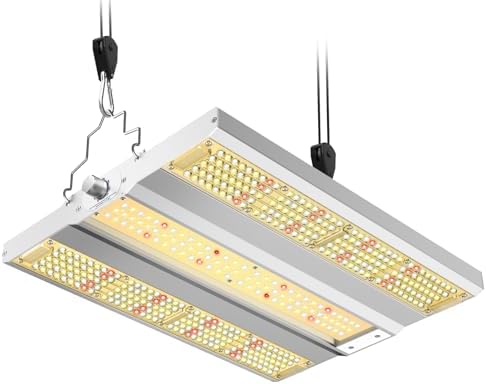
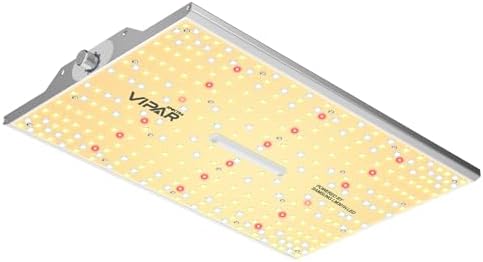
VIPARSPECTRA XS1500 LED Grow Light
$129.98 price checked August 2026
If you are focusing on reproductive growth, see our list of top-performing grow lights for blossom and fruiting.

What Happens if You Under-Provision or Over-Buy?
Under-provisioning occurs when the PPFD delivered to the canopy is lower than the biological requirements of the plant. If you provide too little light, plants undergo “stretching” or etiolation, where they grow tall and spindly as they search for a stronger light source. This results in weak stems that may collapse under their own weight and smaller leaf surface areas. In many cases, under-provisioning leads to stunted growth where the plant remains in a perpetual juvenile state, failing to produce fruit or flowers because it lacks the energy to trigger those reproductive cycles.
For those keeping foliage healthy inside, view our comparison of the best grow lights for indoor plants.
The Real Cost of Over-Buying Grow Lights
Over-buying happens when you select a light capable of delivering much higher PPFD than your space or plant type can actually utilize. While it might seem like a “future-proof” move, excessive light creates a measurable waste of electricity and generates unnecessary heat. High-output fixtures require significant power to maintain high PPFD levels; if your plants only need 400 µmol/m²/s but you buy a fixture capable of 1,200 µmol/m²/s, you are paying for capacity you will never use. Furthermore, excessive light can lead to photoinhibition, where the plant’s photosynthetic machinery becomes overwhelmed and actually slows down growth to protect itself from damage.
The Mistake Most Buyers Make with PPFD
The most common mistake is equating total wattage with the PPFD delivered to the plant canopy. Many buyers assume that a 1,000W light will provide a specific amount of PPFD, but wattage is a measure of energy consumption, not light distribution. A light can have a high wattage but poor optics, resulting in a “hot spot” directly under the diodes and very low PPFD just a few inches away. You should optimize for light distribution and the actual PPFD at the canopy level, rather than the power draw of the fixture.
Optimizing for Uniformity
Instead of looking at the total power, focus on the fixture’s ability to provide uniform PPFD across the entire grow area. A fixture with a high peak PPFD that drops off rapidly creates “dead zones” where plants will underperform. Look for specifications that describe the spread of the light and the distance at which the target PPFD is maintained. This ensures that every plant in your canopy receives the required energy, rather than just the ones directly in the center.
How PPFD Interacts with Other Deciding Specs
PPFD is a vital metric, but it is often limited by the thermal management of the grow light. If a fixture is not designed to dissipate heat efficiently, the LEDs will experience thermal throttling. This means that even if the light is capable of high PPFD, the internal temperature will cause the diodes to dim or reduce output to prevent permanent damage. When evaluating a grow light, the heat sink design is just as important as the PPFD rating to ensure consistent light levels over long periods.
The Role of Spectral Balance
PPFD measures the total amount of usable light, but it does not describe the quality of that light. A high PPFD reading can still result in poor growth if the spectral balance is incorrect. For example, a light with an imbalance of too much blue light might result in stunted, overly compact plants, while too much red light without proper balance can lead to “stretching.” The PPFD tells you how much “food” the plant is getting, but the spectrum tells you what kind of “nutrients” that food contains.
Distance and Canopy Coverage
The distance between the light and the plants is the primary variable in determining the final PPFD. Because light intensity follows the inverse-square law, doubling the distance from the light source reduces the PPFD to one-quarter of its original value. You must confirm the distance at which the fixture provides your target PPFD. If a fixture provides 900 µmol/m²/s at 12 inches, it may only provide 200 µ/m²/s at 36 inches, making it unsuitable for large-scale setups where height is a factor.