
When shopping for a grow light, the most important distinction is between functional output and marketing fluff. Terms like “blazing,” “revolutionary,” or “professional-grade” do not provide data on how much light your plants will actually receive. To make a successful purchase, you must ignore these adjectives and focus on three specific categories of data: the intensity of the light (PPFD and PAR), the efficiency of the hardware (lumens and diodes), and the thermal management of the fixture. This guide decodes those technical specifications so you can determine what a specific dollar amount actually buys for your grow space.
Understanding Grow Light Output Metrics
- PPFD (Photosynthetically Active Radiation Flux Density) – This measures how many photons of usable light hit a specific area in micromoles per second per square meter (µmol/m²/s). A higher PPFD value is better, as it directly correlates to the energy available for photosynthesis.
- PAR (Photosynthetically Active Radiation) – This is the total amount of light within the 400 to 700 nanometer spectrum that plants can use. While PPFD measures intensity at a specific point, PAR describes the total usable light available in the space.
- PPFD Thresholds – High-intensity flowering and fruit production typically require a PPFD of 900 µmol/m²/s or higher at the canopy. If a fixture cannot reach this threshold at your desired height, it may be under-provisioned for large plants.
- Luminous Flux (Lumens) – Lumens measure the total amount of light emitted in all directions, including wavelengths humans see but plants cannot use. While helpful for general room brightness, a high lumen count does not guarantee high PPFD for plants.
- Lux – This is a measure of light intensity as perceived by the human eye. Because plants do not see light the same way humans do, lux is a secondary metric and should not be the primary way you judge a grow light’s performance.
Where these choices show up in our reviews
These 3 have their own full review on this site, and run from $129.99 to $129.99.
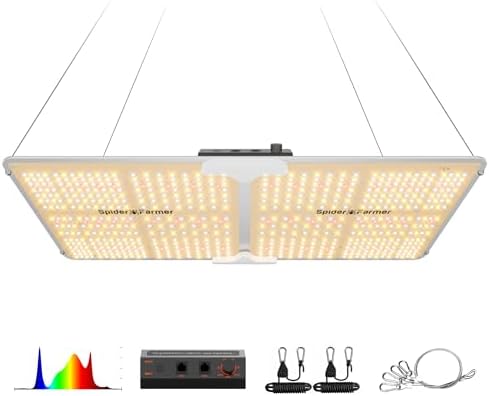
Spider Farmer SF2000 200W LED Grow Light
$129.99 price checked August 2026
Read our full Spider Farmer SF2000 review
If you are building a water-based setup, you can compare the best grow lights for hydroponic plants to find the right fit.


KINGLED KP3000 LED Grow Lights
For those just starting a new garden, see which grow lights for seedlings provide the most consistent results.
$129.99 price checked August 2026
Grow Light Hardware and Efficiency Specs
- Samsung LM301H/LM301H EVO – These are specific high-efficiency LED diodes that have become the industry standard for professional fixtures. Using these diodes generally means the light produces more PAR for every watt of electricity consumed.
- Wattage (W) – This indicates the power consumption of the fixture. While higher wattage allows for more light, it also increases electricity costs; the goal is to find a fixture that provides high PPFD at a reasonable wattage.
- Binning – This refers to the process of grouping LEDs with similar color temperatures and brightness levels. High-quality binning ensures that the light output remains consistent across the entire fixture, preventing “hot spots” or dim areas.
- Thermal Management – This refers to the heat sink design and cooling method used to keep the LEDs at a safe operating temperature. Better thermal management prevents thermal throttling, which occurs when LEDs dim to protect themselves from overheating.
- Color Temperature (Kelvin – K) – This measures the “warmth” or “coolness” of the light. For most indoor grows, a full-spectrum light covering 3000K to 5000K is preferred to ensure a balance of blue and red wavelengths.
Physical and Installation Specs
- Footprint – The physical dimensions of the fixture. You must ensure the fixture fits within your space and that the hanging points are accessible.
- Weight – The total mass of the fixture, including the heat sink and housing. Heavier fixtures often indicate larger heat sinks, which can improve longevity and light consistency.
- IP Rating – This measures the fixture’s resistance to dust and water (e.g., IP65). A higher IP rating is better if you plan to use the light in a high-humidity environment or a space that requires frequent washing.
- Input Voltage – The electrical requirement for the fixture, typically 110V or 220V. You must confirm your local power supply matches the fixture’s requirements before ordering.
- Cabling Length – The length of the power cord provided. If your power source is far from your grow area, you may need to factor in the cost of an extension cable.
Common Grow Light Term Confusions
Several terms in the grow light industry are often used interchangeably by sellers, but they represent different physical properties. Understanding these differences helps you identify when a listing is using a less impressive metric to mask lower performance.
Lumens vs. PPFD
Lumens measure the light humans see; PPFD measures the light plants use. A fixture can have high lumens but low PPFD if the spectrum is not optimized for photosynthesis. Always prioritize PPFD for plant growth.
You can also learn about the different types of grow lights to understand the technology behind the specs.
Watts vs. PPFD
Wattage is the “cost” of the light (electricity used), while PPFD is the “result” (light received). A more efficient fixture will provide a higher PPF/Watt ratio, meaning it produces more light for less power.
Full Spectrum vs. Red/Blue
“Full Spectrum” refers to a light that covers the entire visible range of colors, which is generally better for plant morphology and aesthetics. “Red/Blue” refers to older technology that only provides the specific wavelengths plants need, often resulting in “purple” light that is harder for humans to work under.
LM301H vs. LM301H EVO
The EVO is a newer iteration of the LM301H diode. While both are high-efficiency standards, the EVO typically offers slightly better binning and manufacturing consistency.
Thermal Throttling vs. Heat Sinking
A heat sink is a physical component (metal fins) used to dissipate heat. Thermal throttling is a failure mode where the light dims because the heat sink is insufficient. A high-quality heat sink prevents thermal throttling from occurring.