
There are four primary types of grow lights distinguished by their light delivery method and intended scale. These categories are separated by how they distribute energy—whether through a single high-intensity point, a broad-spectrum array, or a localized, portable source—which dictates the canopy coverage, heat management, and the specific stage of the plant life cycle they support.
What are High-Output LED Arrays?
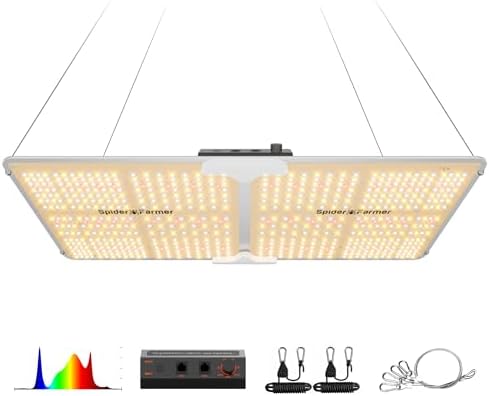
High-output LED arrays are the industry standard for large-scale indoor cultivation and professional-grade setups. These fixtures use multiple high-efficiency diodes, such as the Samsung LM301H or LM301H EVO, to provide a consistent PAR (Photosynthetically Active Radiation) across a wide area.
These arrays are designed for growers who require high-intensity flowering and fruit production. By spreading the light source over a large surface area, they minimize hot spots and provide a more uniform light distribution compared to single-point sources. This makes them ideal for 3x3ft canopies or larger where consistent PPFD (Photosynthetic Photon Flux Density) is required throughout the growth cycle.
While they offer the most consistent light distribution, they require significant power and advanced thermal management to prevent thermal throttling. These units sit at the highest price point in the grow light category due to the quantity of diodes and the necessary cooling hardware.
Where these choices show up in our reviews
Prices across these 3 run from $115.59 to $129.99; each one has a full review here.

Spider Farmer SF1000
$115.59 price checked August 2026
You can find our curated list of top-rated lights for vegetative and flowering stages to help you choose the right gear.

KINGLED KP4000 LED Grow Lights
If you are a beginner, you should learn the fundamentals of how grow lights work before buying.
$129.99 price checked August 2026
What are LED Bar Lights?
LED bar lights are linear fixtures designed to provide targeted illumination in narrow spaces or to supplement existing lighting. They consist of a series of LEDs arranged in a long, thin strip, allowing for flexible placement between plants.
Bar lights suit growers with high-density shelving or vertical setups where a wide array would be too bulky. They are excellent for filling in “dead zones” or providing extra light to lower shelves in a multi-tier rack. Because they are narrow, they allow for better airflow between plants, which helps manage humidity and temperature.
The trade-off for this flexibility is a lower total output per square foot compared to a full array. They are generally positioned in the mid-range of the market, offering a balance between specialized coverage and cost.
What are LED Spotlights?
LED spotlights are high-intensity, concentrated light sources designed to focus energy on a specific, small area. They use reflectors or lenses to direct the light downward in a tight beam.
For a clearer understanding of technical data, see our breakdown of common grow light specifications in plain English.
Spotlights are best for hobbyists with limited space or for growers who need to provide intense light to specific, high-value plants like bonsai or individual large tropicals. They provide a high concentration of light in a very small footprint, making them easy to move and reposition as a plant grows.
The primary compromise is the risk of spectral imbalance or “hot spots” if the light is too close to the foliage. Because the light is concentrated, it can also create localized heat issues. These are typically the most affordable option for small-scale use.
Grow Light Type Comparison
| Grow Light Type | Best-Fit Buyer | Main Advantage | Main Compromise |
|---|---|---|---|
| High-Output Array | Commercial or large-scale hobbyist | Uniform light distribution | High power and cost |
| LED Bar Light | Vertical or high-density shelving | Flexible placement | Lower output per square foot |
| LED Spotlight | Small-space or decorative hobbyist | Concentrated light beam | Risk of hot spots |
How do you choose the right grow light type?
You should choose a high-output LED array if you are growing large crops in a dedicated room and require a consistent PPFD of 900 µmol/m²/s or higher for flowering. This is the choice for when your primary goal is maximizing yield across a large, uniform canopy.
You should choose an LED bar light if your setup involves multiple levels of shelving or if you need to provide supplemental light to the lower sections of a dense grow area. This is the choice for maximizing vertical space and maintaining airflow in crowded environments.
You should choose an LED spotlight if you are growing a few individual plants in a small area, such as a closet or a countertop. This is the choice for when space is your primary constraint and you only need to provide high-intensity light to a specific, small target.
Before ordering any type, you must confirm your power supply can handle the fixture’s wattage and ensure the light’s dimensions fit your available ceiling or shelf space. Because these fixtures are often heavy or require specific mounting, you should consult a qualified installer to ensure the mounting is structurally sound and meets local electrical codes.