
Green Writer is reader-supported: some links on this page are affiliate links, and as an Amazon Associate Green Writer earns from qualifying purchases at no extra cost to you. Learn more.
Whole house water filtration certifications are voluntary standards that verify a system’s ability to reduce specific contaminants. Most residential systems require no government-mandated certification to be sold, though voluntary marks from recognized bodies indicate a product has undergone independent laboratory testing. You need a system with specific certifications if your local water contains heavy metals, chemicals, or high levels of sediment that exceed your local utility’s treatment capacity. Check your local water quality report to see if your area has high levels of lead or nitrates before selecting a filtration standard.
What does the NSF/ANSI 42 standard guarantee?
The NSF/ANSI 42 standard is a certification issued by the National Sanitation Foundation that focuses on the aesthetic effects of water filtration. This standard confirms that a system can reduce chlorine, taste, and odor, which are the most common issues in municipal water supplies. It provides a benchmark for how much of these substances a filter will remove based on specific flow rates and contact times. However, the NSF/ANSI 42 mark does not guarantee the removal of heavy metals, pathogens, or chemicals like PFAS.
NSF 42 certification removes chlorine and chemical tastes from water
Because this standard is focused on aesthetics, it is often the baseline for carbon block filters. If your primary goal is to remove the “pool” smell or the chemical taste of city water, this is the relevant certification. It ensures the media inside the housing is capable of adsorbing chlorine molecules effectively. If you are looking for a system to address health-related concerns, you must look for a higher-tier certification beyond the 42 standard.
Understanding your options begins with learning about the different types of whole house water filtration systems.
Where these choices show up in our reviews
From $349.99 to $996.55: 3 of the 15 in this category we have reviewed in full.


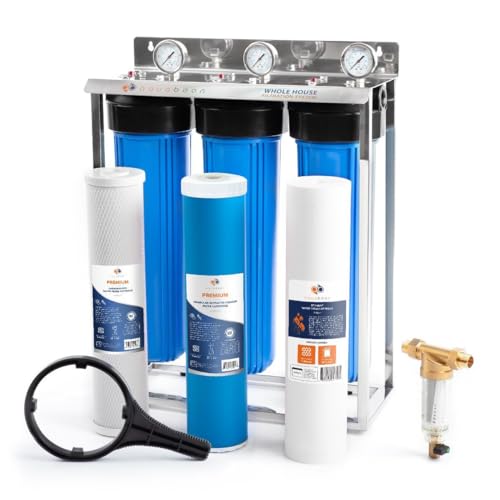
What does the NSF/ANSI 53 standard guarantee?
The NSF/ANSI 53 standard is a certification that validates a system’s ability to reduce contaminants that have health implications, such as lead, mercury, and certain types of cysts. This standard requires more rigorous testing than the 42 standard because it involves substances that can accumulate in the body over time. It ensures that the filtration media has the specific surface area and chemical properties to trap these smaller or more persistent particles. The NSF/ANSI 53 mark does not guarantee the removal of all chemicals or the reduction of total dissolved solids (TDS).
If a large system is too complex, explore the alternatives to a whole house water filtration system for similar results.
NSF/ANSI 53 certification prevents lead from leaching into drinking water
A system with this certification is necessary if your home has older plumbing where lead leaching is a risk. For example, if you live in a home built before 1986, the presence of lead in the solder or pipes makes this standard a priority. Does your local water report show lead levels above 0.015 mg/L? If so, you should prioritize a system that specifically lists NSF/ANSI 53 certification for lead reduction. This certification provides a level of assurance that the filtration media is dense enough to prevent these heavy metals from passing through into your drinking water.
What does the NSF/ANSI 58 standard guarantee?
The NSF/ANSI 58 standard is the specific certification for reverse osmosis (RO) systems, which are distinct from standard carbon or sediment filtration. This standard verifies that the RO membrane can reduce a wide range of contaminants, including arsenic, nitrates, and fluoride, to specific percentage levels. Because RO is a high-pressure membrane process, the 58 standard is much more comprehensive than 42 or 53. It does not guarantee that the system will provide a specific flow rate or that the waste water output will be minimized.
NSF/ANSI 58 systems remove nitrates and arsenic through multi-stage filtration
If you need to remove nitrates or arsenic, which are not effectively handled by standard carbon filters, an NSF/ANSI 58 certified system is the standard choice. This certification is often required for systems intended to provide high-purity drinking water at the point of use. It ensures that the multi-stage process—usually involving a sediment pre-filter, a carbon block, and the RO membrane—works in a sequence that protects the membrane while maximizing contaminant removal.
For a more compact setup, see our full Express Water Essential spec breakdown.
Which safety failure modes does these standards address?
The primary safety failure mode in whole house water filtration is media breakthrough, which occurs when the filtration media becomes saturated and allows contaminants to pass through. Standards like NSF/ANSI 53 are designed to define the limits of this breakthrough by testing how long a filter can operate before its effectiveness drops. Without these certifications, a filter might appear to work initially but fail to provide protection after only a few months of use.
Proper housing design prevents pressure drops and whistling in home plumbing
Another failure mode is pressure drop, where a filter with insufficient surface area restricts the flow of water to your home. While most NSF standards focus on water quality, the design of the housing must also account for the flow requirements of a standard residential connection. If a filter is too small for your home’s needs, it can cause whistling in the pipes or a decrease in shower pressure. A well-designed system balances the surface area of the media with the required flow rate to ensure the system doesn’t become a bottleneck for your plumbing.
View our data-driven analysis in our full Express Water WH100SC review.
Matching filter flow rates to high-flow showerheads prevents pressure loss
Pressure drop can be a significant issue if you have a high-flow showerhead. If the filter’s internal diameter is too small, the friction of the water passing through the media will reduce the pressure at the showerhead. You should check the flow rate of your highest-demand fixture before purchasing a system to ensure the filter‘s rated capacity matches your household’s peak usage.
How can a buyer verify a certification is real?
Verifying a certification ensures that the mark on the box is backed by a laboratory test rather than being a marketing claim. Because labels can be easily printed, you must look for specific identifiers to confirm a system’s credentials. Use the following steps to verify the certification of a filtration system:
See the performance specs in our full review of the iSpring WGB12B.
- Locate the specific certification number or “NSF” logo on the physical product housing or the official manufacturer’s documentation.
- Visit the official NSF International website and use their “Certification Search” tool to enter the manufacturer’s name or the specific model number.
- Confirm that the specific contaminant you are concerned about (such as lead or nitrates) is explicitly listed under the certification results.
- Check that the certification is still current, as some certifications expire or are updated to newer versions of the standard.
- Verify that the certification applies to the specific configuration of the product, as some parts of a system may be certified while others are not.
Which marks are non-negotiable for whole house water filtration?
The non-negotiable marks for whole house water filtration depend entirely on the specific contaminants present in your local water supply. If your water is treated by a municipal source and you primarily want to improve taste, the NSF/ANSI 42 standard is a reliable baseline for carbon filtration. However, if you are dealing with heavy metals or chemical contaminants, the NSF/ANSI 53 standard becomes a mandatory requirement for safety.
Balancing NSF 58 safety standards with long-term media service life
For users who require the removal of nitrates or arsenic, the NSF/ANSI 58 standard for reverse osmosis is the only way to ensure those specific contaminants are addressed. You should weigh these certifications against the total filtration capacity of the system to ensure the media won’t need frequent replacement. A system that meets a high safety standard but has a very small filtration capacity may require you to replace the cartridges every few months, increasing the long-term cost of ownership. Balance the necessity of the certification with the practicalities of the media’s service life to find the right fit for your home.
More whole house water filtration explainers and comparisons
- The Whole House Water Filters That Work Best for Hard Water Scale
- Which Whole House Water Filter Is Best for Iron and Manganese?
- Best Whole House Water Filters for Sediment and Rust
- Whole House Water Filters for Chlorine and Odor Compared
- Choosing the Best Whole House Water Filter for Large Families
- Removing Well Water Smell With a Whole House Water Filter