
Green Writer is reader-supported: some links on this page are affiliate links, and as an Amazon Associate Green Writer earns from qualifying purchases at no extra cost to you. Learn more.
Whole house water filtration systems come in four primary types defined by their primary treatment mechanism: carbon filtration, sediment filtration, ion exchange, and ultraviolet sterilization. A buyer needs to identify the specific contaminants present in their supply—such as chlorine, sediment, or minerals—before selecting a system, as most carbon-based systems cannot remove hardness. You should measure your local water’s hardness and turbidity levels to determine if you require a multi-stage approach or a single-stage solution.
How Carbon Filtration Systems Improve Water Taste and Remove Odors
Carbon filtration systems use granulated activated carbon or carbon block media to adsorb chemicals, improve taste, and remove odors from the water supply. These systems are the standard for households primarily concerned with chlorine, volatile organic compounds (VOCs), and aesthetic issues like bad-tasting water. They perform better than sediment-only systems at chemical removal but provide no protection against biological pathogens or heavy minerals like calcium.
How carbon filtration systems reach saturation and require media replacement
The primary compromise of a carbon-only system is its limited capacity for heavy metals or minerals. Because carbon is a porous material, it eventually reaches a saturation point where it can no longer trap contaminants, requiring a full media replacement. These systems typically sit in a mid-range price bracket relative to other whole house solutions, as they often require larger housing units to achieve the necessary contact time for effective chemical adsorption.
Why sizing a carbon system for peak flow ensures better taste
A buyer who installs a carbon system for a high-flow home without sufficient contact time may find that the water still tastes of chlorine. This occurs when the flow velocity is too high for the carbon to trap the chemicals before the water exits the housing. To avoid this, the system must be sized to handle the peak gallon-per-minute (GPM) demand of the household.
Before ordering, make sure to learn how to choose your inlet and outlet size for a proper installation.
Where these choices show up in our reviews
Prices across these 3 run from $255.98 to $1310.99; each one has a full review here.
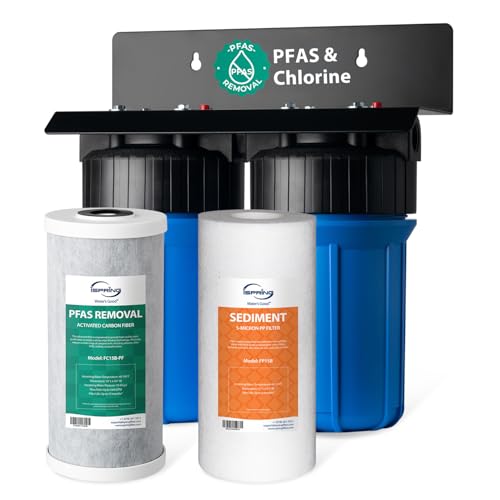
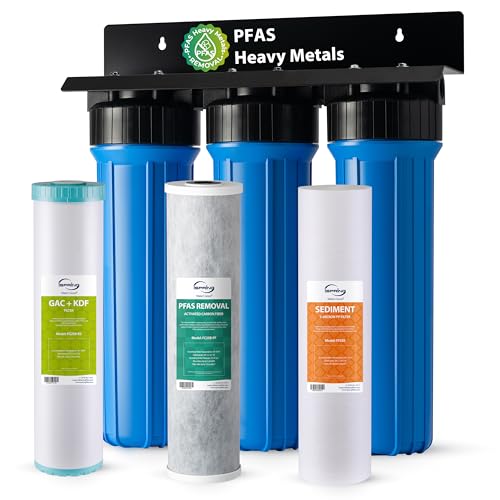

How Sediment Filtration Systems Trap Solid Particles and Protect Appliances
Sediment filtration systems use pleated, spun, or string-wound cartridges to physically trap solid particles like sand, silt, and rust. These systems are for homeowners who need to protect appliances, such as washing machines and water heaters, from clogging and internal damage. They excel at removing large physical debris but do nothing to improve the chemical composition or taste of the water.
Why sediment filtration systems are affordable but do not remove chemicals
The trade-off for a sediment-focused system is that it does not address dissolved solids or chemical contaminants. If the water is chemically “hard” or contains chlorine, a sediment filter will not improve the water quality. These systems are generally the most affordable whole house filtration options, as the focus is on physical capture rather than complex chemical exchange or sterilization.
How sediment filters prevent premature water heater failure from debris
If a buyer ignores high sediment levels and relies only on a chemical filter, the internal valves and heating elements of their water heater may fail prematurely due to mineral buildup and debris. This can lead to expensive repairs or the need to replace the appliance entirely. A sediment filter acts as the first line of defense, ensuring that subsequent filtration stages do not become prematurely clogged with dirt.
For a high-performance multi-stage solution, see our full Express Water Essential review for a detailed spec breakdown.
How Ion Exchange Softeners Remove Water Hardness and Scale
Ion exchange softeners use a resin bed to swap calcium and magnesium ions for sodium or potassium ions, effectively removing water hardness. These are for households dealing with “hard water” that causes scale buildup on faucets and prevents soap from lathering. They are the standard for hardness removal which most carbon-based filters cannot perform.
Why ion exchange softeners are expensive and specific to mineral content
While they excel at preventing mineral scale, ion exchange softeners do not remove most chemicals, sediments, or biological contaminants. They are a specific solution for mineral content rather than a general purification system. Because they require a large brine tank and a resin tank, these systems sit in the highest price bracket of the categories discussed on this page.
Why ion exchange systems are needed to stop mineral scale buildup
A resident who experiences white crusty buildup on showerheads needs an ion exchange system rather than a carbon filter. While a carbon filter might improve the taste of the water, it will not stop the calcium from depositing on surfaces. Choosing an ion exchange system requires a consistent supply of salt or potassium to regenerate the resin beads that perform the mineral swap.
How UV Sterilization Units Neutralize Bacteria and Pathogens
UV sterilization units use ultraviolet light to disrupt the DNA of bacteria, viruses, and protozoa, rendering them unable to reproduce. These systems are for households requiring biological protection, such as those on private wells or in areas with known groundwater contamination. They provide a level of biological safety that chemical filtration cannot guarantee.
You can also research the Express Water WH100SC performance specs to see how it handles common contaminants.
Why UV systems require a preceding sediment filter to work
The primary compromise of UV systems is that they do not remove any physical particles, chemicals, or minerals from the water; they only neutralize biological threats. Because the water must be clear for the UV light to reach every drop, these units are almost always installed after a sediment filter. These systems sit in a high price bracket, often requiring specialized electrical components and specialized lamps.
How sediment can shield bacteria from UV sterilization if unfiltered
A buyer who installs a UV unit without a preceding sediment filter may find the system fails to protect the home. If the water is turbid, the sediment can “shield” bacteria from the UV light, allowing pathogens to pass through the system. Proper installation requires a multi-stage setup where the sediment filter ensures the water is clear enough for the UV light to be effective.
Comparison of Advantages and Compromises for Different Filtration Types
| Type | Best-Fit Buyer | Main Advantage | Main Compromise |
|---|---|---|---|
| Carbon Filtration | Homeowners seeking better taste and odor | Removes chlorine and VOCs | Does not remove hardness or pathogens |
| Sediment Filtration | Homeowners with sand, silt, or rust in pipes | Protects plumbing and appliances | Does not improve water taste or chemistry |
| Ion Exchange | Homeowners with hard water and scale buildup | Removes calcium and magnesium | Does not remove chemicals or sediment |
| UV Sterilization | Homeowners needing biological pathogen removal | Neutralizes bacteria and viruses | Does not remove minerals or chemicals |
Which Whole House Water Filtration Type Suits Your Needs?
You belong in the carbon filtration category if your primary concern is the taste and smell of your water. If your water smells like a swimming pool after a heavy rain or if your local municipality uses heavy chlorination, a carbon system is the priority. You should look for a system that provides sufficient contact time to ensure the chlorine is fully adsorbed before it reaches your faucets.
For a compact and efficient option, see our full Hardless NG4L Filter review to view the technical data.
When ion exchange softeners are needed for soap lathering and film
You need an ion exchange softener if you notice white mineral deposits on your showerhead or if your soap does not lather well. If the water feels “heavy” or leaves a film on your skin, you are dealing with hardness that requires a resin-based swap. This is a distinct requirement from chemical filtration, and a carbon filter will not solve this issue.
Why sediment filtration systems are necessary for grit and rust
You require a sediment filtration system if your water contains visible particles or if your plumbing is older and prone to rust. If you notice “grit” in your water or if your showerhead frequently clogs, a sediment filter is the necessary first step. This protects the longevity of your home’s internal plumbing and prevents the premature failure of high-cost appliances.
When UV sterilization is required for private well biological safety
You should consider UV sterilization if you are on a private well or if your water source is known to contain biological contaminants. If you need to ensure that the water is safe from bacteria and viruses, UV is the benchmark for biological pathogen removal. This is a specialized requirement that is separate from the chemical and mineral concerns addressed by the other systems.
How multi-stage systems address complex water profiles with multiple contaminants
You may need a multi-stage system if your water contains multiple types of contaminants. For example, if you have hard water that also tastes of chlorine, you would combine an ion exchange softener with a carbon filtration system. If you have well water with sediment and bacteria, you would combine a sediment filter, a carbon filter, and a UV sterilization unit. Matching the system to your specific water profile ensures you do not spend money on a solution that ignores your primary problem.
Homeowners seeking a streamlined setup can see our PUREPLUS 2-Stage Filtration review for a detailed breakdown.
How These Systems Compare to Industry Benchmarks
The category of whole house water filtration is often measured against several industry standards. Multi-Media Tanks serve as the benchmark for high-flow sediment removal, using large-scale gravity-fed systems to handle heavy loads of debris. The products on this page often focus on cartridge-based or pressurized systems, which offer a more compact footprint than multi-media gravity tanks but may require more frequent maintenance to prevent media breakthrough.
Ion Exchange Softeners are the standard for hardness removal which most carbon-based filters cannot perform. While carbon filters focus on the chemical “feel” of the water, ion exchange focuses on the mineral “build-up.” If a system cannot perform ion exchange, it is not a softener, regardless of its other filtration capabilities. This distinction is critical for anyone trying to prevent limescale in a kitchen or bathroom.
UV Sterilization Units are the benchmark for biological pathogen removal that chemical filtration cannot guarantee. Chemical filters rely on the presence of additives like chlorine to kill bacteria, but if those chemicals are absent, the filtration is purely physical or chemical. UV units provide a physical change to the water’s safety profile without adding chemicals to the supply. When comparing a system to a UV unit, the focus is on whether the system provides a biological “kill” step or merely a physical “trap” step.
Browse our other whole house water filtration pages
- Removing Well Water Smell With a Whole House Water Filter
- Best Whole House Water Filters for PFAS Removal
- Whole House Water Filters for Heavy Metals Compared
- Choosing the Best Whole House Water Filter for Chloramine
- The Whole House Water Filters That Work Best for Hard Water Scale
- Which Whole House Water Filter Is Best for Iron and Manganese?