
Green Writer is reader-supported: some links on this page are affiliate links, and as an Amazon Associate Green Writer earns from qualifying purchases at no extra cost to you. Learn more.
Whole house water filtration systems generally cost between $111.57 and $2,476.67. As the price rises, the median filtration capacity increases from 30,000 gallons to 100,000 gallons, while the median price per unit of filtration capacity drops from $0.00 to $0.01.
A Whole House Water Filtration System Price Levels at a Glance
| Price level | Price range | Products | Median filtration capacity | Median filter media diameter | Median rating |
|---|---|---|---|---|---|
| Entry level | $111.57 to $249.99 | 13 | 30,000 Gallons | 10″ | 4.4 |
| Lower mid-range | $255.98 to $404.98 | 13 | 65,000 Gallons | 15″ | 4.4 |
| Upper mid-range | $404.98 to $551.36 | 13 | 100,000 Gallons | 20″ | 4.6 |
| Top end | $559.23 to $2476.67 | 13 | 100,000 Gallons | 20″ | 4.1 |
Products in this category with a full review here
From $131.99 to $349.99: 3 of the 15 in this category we have reviewed in full.


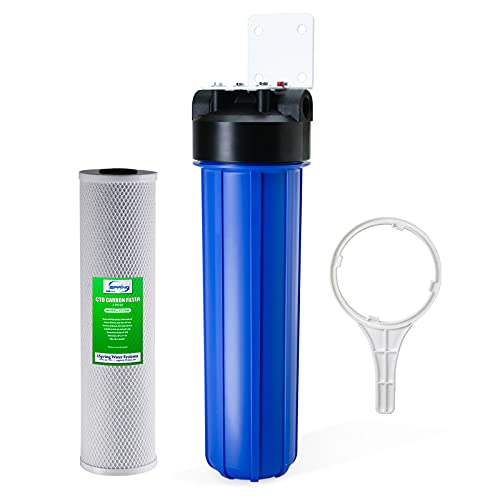
What does an entry level whole house water filtration system offer?
An entry level whole house water filtration system provides a median filtration capacity of 30,000 gallons and a median filter media diameter of 10 inches. These systems are designed for basic water treatment where the primary goal is to address immediate water quality concerns without high-volume requirements.
If your primary concern is safety, view our comparison of the best whole house water filter for heavy metals.
Entry level systems provide basic protection for small households
If you have a small household or a specific area of the home that requires filtration, these systems provide a baseline of protection. They are suitable for users who prioritize a low initial purchase price over high-capacity longevity or advanced chemical reduction. However, these systems lack the capacity of higher tiers; for example, they do not reach the 150,000 gallon reference figure, which marks the typical lifecycle capacity for a standard 20-inch sediment/carbon cartridge.
Because these units have smaller media diameters, they may require more frequent maintenance than mid-range options. Choosing this level means accepting a shorter service life between cartridge replacements to keep the initial investment near the $149.95 median price point.
Homeowners dealing with nitrogen-based compounds should see our guide to the best whole house water filter for chloramine.
What does a lower mid-range whole house water filtration system offer?
A lower mid-range whole house water filtration system offers a median filtration capacity of 65,000 gallons and a median filter media diameter of 15 inches. This price point introduces more robust filtration capabilities, including a median PFAS reduction rate of 99% for some models in this bracket.
15-inch media diameter extends service life for average residential use
This level suits homeowners who need a balance between cost and longevity. The larger 15-inch media diameter allows for more material to be packed into the housing, extending the time between services compared to entry-level units. It provides a significant jump in capacity from the 30,000-gallon entry level, making it a practical choice for average residential use.
To address specific mineral issues, see our analysis of the best whole house water filter for iron and manganese.
Lower mid-range systems may have lower PFAS reduction rates
While these systems offer improved capacity, they still fall short of the high-volume requirements of larger properties. Only one of the six models stating a specific capacity in this bracket reaches the 150,000 gallon reference figure. Compared to the upper mid-range, these units may provide lower PFAS reduction rates and smaller media diameters, which can impact how long the filter remains effective before media breakthrough occurs.
What does an upper mid-range whole house water filtration system offer?
An upper mid-range whole house water filtration system provides a median filtration capacity of 100,000 gallons and a median filter media diameter of 20 inches. These systems often feature a 99% PFAS reduction rate and are designed for high-demand residential environments.
For high-debris environments, we recommend looking at the best whole house water filter for sediment and rust.
20-inch media diameter prevents pressure drops in high volume systems
This level is for users who require a high volume of treated water and want to minimize the frequency of filter changes. The 20-inch media diameter is a significant size for whole house water filtration, allowing for a larger surface area to trap contaminants. This larger surface area helps prevent a pressure drop, which occurs when a filter with too small a surface area restricts flow to showers and appliances.
Upper mid-range systems offer durable solutions for high water usage
The upper mid-range is where many systems begin to reach the 150,000 gallon reference figure, with four out of the 11 models in this bracket meeting that benchmark. While the price increases to a median of $473.68, the jump in capacity provides a more durable solution for large families or homes with high water usage. Compared to the lower mid-range, you gain significantly more filtration capacity and a larger media diameter, which directly correlates to a longer service life.
You can also find the best whole house water filter for chlorine and odor to improve your water’s taste.
What does a top end whole house water filtration system offer?
A top end whole house water filtration system provides a median filtration capacity of 100,000 gallons and a median filter media diameter of 20 inches, with a median price of $996.55. These premium systems focus on high-quality construction and specialized filtration configurations.
Specialized build quality defines the high price of certain systems
This level suits users who prioritize specific build quality or specialized filtration media over sheer volume of capacity. While the median capacity is 100,000 gallons—the same as the upper mid-range—the higher price point often reflects specialized housing materials or advanced configurations. Interestingly, none of the four models in this bracket that state their capacity reach the 150,000 gallon reference figure.
For those on private wells, explore different whole house water filters for well water smell to improve air quality.
Top end systems offer specialized hardware over higher filtration volumes
By choosing the top end, you are paying for features beyond basic volume. This might include specialized housing materials or configurations that prioritize specific contaminant removal. However, because the median capacity remains at 100,000 gallons, the primary gain over the upper mid-range is not in the amount of water treated, but in the specific attributes of the hardware itself.
Where does paying more stop buying more for whole house water filtration?
The point where paying more stops buying more for whole house water filtration occurs when the filtration capacity plateaus at 100,000 gallons while the price continues to rise toward the $2,476.67 mark. The median price per unit of filtration capacity stays at $0.00 for the first three tiers, but rises to $0.01 at the top end.
Learning about the various types of whole house water filtration systems helps you choose the right technology.
Price jumps significantly when moving from upper mid-range to top end
In the lower mid-range, the median price is $349.99 for 65,000 gallons. Moving to the upper mid-range, the price increases to a median of $473.68 for 100,000 gallons. This represents a significant gain in capacity for a moderate increase in cost. However, moving from the upper mid-range to the top end, the median price jumps to $996.55 while the median capacity remains at 100,000 gallons.
High price levels prioritize non-capacity features over total gallons
This means that at the highest price levels, you are no longer paying for more gallons of treated water. The cost per gallon of filtration capacity increases, indicating that the extra expenditure is directed toward non-capacity features. If your primary goal is the highest volume of water treated for the lowest cost, the upper mid-range represents a point of high efficiency where the gain in capacity is still significant.
For a specific multi-stage option, check our full Express Water Essential review.
What to budget for on top of the whole house water filtration unit?
Beyond the initial purchase of the whole house water filtration system, you must budget for several essential components and ongoing maintenance. These costs are necessary to ensure the system functions correctly and remains effective over time.
Replacement cartridges require specific matching to the housing dimensions
You will need a Replacement Cartridge to ensure the system continues to filter water after the media is exhausted. The cost of these cartridges depends on the specific model and the frequency of your water usage. It is important to confirm that the replacement cartridge matches the specific housing and dimensions of your unit before ordering.
High-flow needs can be met by looking at our full PUREPLUS 2-Stage Filter review.
Bypass valves and pressure gauges are essential for system maintenance
A Bypass Valve is another necessary component, as it allows water to flow to the house while the system is being serviced. This ensures that your home does not lose water pressure during maintenance. You must ensure the bypass valve is compatible with your existing plumbing connections. Additionally, a Pressure Gauge is a useful addition to monitor the pressure drop to indicate when filters need replacement. These components are essential for the practical operation of the system and should be factored into your total budget.
How do you determine a fair price for whole house water filtration?
To determine a fair price for whole house water filtration, you should calculate the price per unit of filtration capacity and compare it to the median figures. This calculation helps you see the actual cost of the water treatment you are purchasing.
Alternatively, you may want to see our full PUREPLUS 2-Stage Filtration review for different specs.
A fair price is found by dividing the total cost of the system by its filtration capacity. You can compare this result against the median prices provided in the research: $0.00 for the first three tiers and $0.01 for the top end.
Evaluating price per unit of capacity identifies the best value
When you see the price per unit of filtration capacity rise, it indicates that you are paying for more than just volume. If you are looking for the most efficient use of your budget, seek a system where the price per unit is closest to the lower medians. This ensures you are getting the maximum amount of filtration for every dollar spent. If you find a system where the price per unit is significantly higher than $0.01, you should evaluate what specific features or materials justify that premium.
For advanced contaminant removal, see our full iSpring WGB21B-PFKS review.
When you are deciding on a system, check your home’s annual water usage. If your household uses 50,000 gallons a year, a system with a 100,000-gallon capacity provides a two-year service life. If your usage is higher, you may need to choose a system with a larger capacity to avoid frequent media breakthrough, where exhausted media allows contaminants to pass through the system.
The rest of our whole house water filtration guides
- Choosing the Best Whole House Water Filter for Chloramine
- The Whole House Water Filters That Work Best for Hard Water Scale
- Which Whole House Water Filter Is Best for Iron and Manganese?
- Best Whole House Water Filters for Sediment and Rust
- Whole House Water Filters for Chlorine and Odor Compared
- Choosing the Best Whole House Water Filter for Large Families