
Green Writer is reader-supported: some links on this page are affiliate links, and as an Amazon Associate Green Writer earns from qualifying purchases at no extra cost to you. Learn more.
Heating capacity for an above ground pool heater should range from 8,000 BTU to 150,000 BTU depending on the total water volume and desired heating speed. You need a system that matches your pool’s gallon capacity to ensure the water reaches the target temperature within a practical timeframe.
Recommended Heating Capacity by Use Case
| Use Case | Recommended Heating Capacity | Why this number |
|---|---|---|
| Small 2,000 gallon pool | 8,000 to 12,000 BTU | This range provides the baseline energy to maintain a small volume. |
| Medium 5,000 gallon pool | 15,000 to 25,000 BTU | Required to maintain steady temperatures in a standard backyard setup. |
| Large 10,000 gallon pool | 30,000 to 50,000 BTU | Necessary to overcome the thermal mass of a larger body of water. |
| Extra large 20,000 gallon pool | 40,000+ BTU | This reflects the minimum output for high-volume heating requirements. |
| Rapid heating for 3,000 gallons | 15,000 BTU | Derived from the need to raise the temperature of this volume in a single day. |
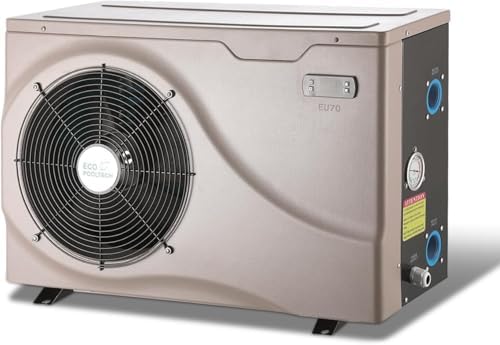
Above Ground Pool Heaters we have reviewed in detail
Prices across these 3 run from $1261.99 to $2564.04; each one has a full review here.


What Happens if You Under-Buy or Over-Buy Heating Capacity?
Under-buying heating capacity for an above ground pool heater means the unit will run continuously without ever reaching the desired setpoint. This occurs because the BTU output is lower than the rate at which the pool loses heat to the air or ground. When a heater is under-sized, it creates a constant cycle of operation that can lead to premature component wear and high electricity costs. The water may stay cool enough for swimming during the day but fail to stay warm overnight as the ambient temperature drops.
If you need dual functionality, see our roundup of heating and cooling heaters.
Over-buying heating capacity can cause temperature overshooting and higher costs
Over-buying heating capacity results in a system that reaches the target temperature very quickly but may struggle to maintain it with precision. While a high BTU rating allows for rapid warming, it can lead to “overshooting” where the water becomes too hot before the thermostat can cycle the system off. A larger unit also consumes more power during its active cycles, which can increase your monthly utility costs if the heater is frequently running to maintain a high temperature. You are paying for a peak performance level that your specific pool volume does not require to stay comfortable.
The Common Mistake with Heating Capacity and What to Optimize Instead
Many buyers make the mistake of selecting an above ground pool heater based solely on the highest BTU number available. They assume a larger number always translates to a better experience, regardless of the actual volume of water they need to heat. This leads to purchasing a massive industrial-scale unit for a small backyard pool, which is an inefficient use of budget and space. Instead of focusing only on the peak BTU output, you should optimize for the balance between heating capacity and your specific gallon volume.
High-capacity needs can be met by viewing our full 58000 BTU Pool Heat Pump review.
Matching pool gallon capacity to the correct BTU rating
To find the right balance, you must determine your pool’s total gallon capacity. If you have a 5,000 gallon pool, a unit with a 35,000 BTU rating—which is the median for the 81 models we evaluated—provides a significant buffer for rapid heating. However, if your pool is only 2,000 gallons, that same 35,000 BTU unit is unnecessary. You should identify your maximum desired temperature rise per hour and match it to a BTU range that supports that speed for your specific volume.
How Heating Capacity Interacts with Other Deciding Specs
Heating capacity is a measure of the total amount of heat energy produced per hour, but it does not work in isolation. The effectiveness of these BTUs is often limited by the flow rate of the water moving through the heat exchanger. If the gallons per minute (GPM) are too low, the water cannot move through the system fast enough to absorb the heat, which can cause the unit to trigger a thermal safety shutdown. You must ensure your pump and plumbing can move enough water to match the BTU output of the heater.
For specific model details, see our full Vidapool VTX016 review.
How available home voltage limits maximum pool heater output
Voltage requirements also dictate which heating capacities are available for your home. Many high-output above ground pool heaters require a 220V power supply to reach their maximum BTU ratings. If your home only has 110V circuits, you are limited to lower heating capacity units. This is a critical check before ordering: verify your available voltage before selecting a high BTU system. If you need a high BTU output but only have 110V, you may need to look for a specific type of heat pump that can achieve those numbers on a standard circuit.
High COP ratings make high BTU heating more cost-effective
The Coefficient of Performance (COP) defines the efficiency of heat produced relative to energy consumed. A high BTU output is more cost-effective when the COP is high, as it means the unit produces more heat for every watt of electricity it draws. If you choose a high-capacity heater with a low COP, your electricity bill will rise significantly during operation. When choosing between two units with similar BTU ratings, a higher COP indicates a more efficient way to reach that heating capacity. We found that the 81 models we evaluated range from 11,568 to 150,000 BTU, but the efficiency of those numbers varies based on the internal technology used.
Compare specific specs by viewing our full KSPF-005L3R1A1 Heat Pump review.
Calculating Your Specific Gallon Volume
To determine your requirements, you must know the exact volume of your pool. For a standard above ground pool, this is usually calculated by multiplying the length by the width by the average depth in feet, then multiplying by 7.5. For example, a 15-foot by 30-foot pool with an average depth of 4 feet holds approximately 13,500 gallons of water. Knowing this number allows you to select a BTU range that ensures your water stays warm even during cold nights.
Selecting pool heater capacity to offset overnight heat loss
How much heat does your specific pool need to stay warm at night? For a 13,500 gallon pool, you would want to target a heating capacity that can offset the overnight heat loss, which for most backyard setups requires a unit in the 30,000 to 45,000 BTU range. If your pool is smaller, you can move toward the lower end of the 11,568 to 150,000 BTU range found in our research. If your pool is larger, you must ensure the heater is large enough to move the volume of water before the sun goes down.
Detailed performance data is available in our full VARMINPOOL KSPF-005L3R1A2 review.
The Impact of Flow Rate on BTU Output
Flow rate is the speed at which water moves through the pool warming system. Even if a heater states a high heating capacity, it can only heat the water that passes through it. If the flow rate is too slow, the heat exchanger can overheat because the water isn’t moving fast enough to carry the heat away. This is a common failure mode where the heater shuts down to protect itself from melting internal components.
Matching pump GPM ratings to the heater’s BTU capacity
Before purchasing, check your pump’s GPM rating. A high-capacity heater requires a pump that can provide enough turnover to keep the heat exchanger cool. If your pump cannot provide the required flow, you cannot utilize the full BTU output of the heater. It is often better to choose a slightly lower BTU heater that matches your existing pump’s flow rate than to buy a high-capacity unit that you cannot fully utilize.
Browse our other pool warming system pages
- Which Pool Heat Pump Is Best for a 5500 Gallon Pool?
- Best Above Ground Pool Heater for Heating and Cooling
- Energy Efficient Pool Heat Pumps Compared
- Choosing the Best Above Ground Pool Heater for 110v Outlet
- The Above Ground Pool Heat Pumps That Work Best for Large Pools
- Which Pool Heater with Wifi App Control is Best?