
Green Writer is reader-supported: some links on this page are affiliate links, and as an Amazon Associate Green Writer earns from qualifying purchases at no extra cost to you. Learn more.
Above ground pool heaters come in three primary types defined by their heating capacity in BTUs. A buyer needs to select a system that provides enough heat energy to raise the temperature of their specific water volume within a reasonable timeframe. You should measure your pool’s total gallon capacity before choosing a type to ensure the unit provides sufficient output.
Above Ground Pool Heater Types Among the Listings We Screened
| Type | What sets it apart | Listings we screened | Price range | Median heating capacity |
|---|---|---|---|---|
| Small Capacity Pool Heaters | heating capacity up to 18,450 BTU | 16 | $498 to $699 | 16,000 BTU |
| Medium Capacity Pool Heaters | heating capacity 18,450 to 58,000 BTU | 22 | $569.05 to $2199 | 31,500 BTU |
| High Capacity Pool Heaters | heating capacity 58,000 BTU and up | 21 | $1082.05 to $7599 | 110,000 BTU |
Counted over the 81 listings this site screened; a listing that does not state the figure a type is defined by is not counted under any type.
Where these choices show up in our reviews
Prices across these 3 run from $540 to $1979.10; each one has a full review here.
To ensure proper circulation, see how to choose your flow rate for above ground pool heaters.
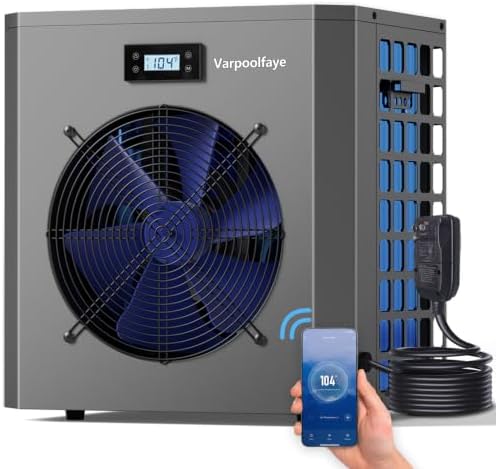


Small Capacity Pool Heaters
Small capacity pool heaters are defined by a heating capacity of up to 18,450 BTU. These systems are intended for smaller backyard pool heaters, such as those heating a few thousand gallons of water. They offer a lower entry point for users who need to maintain a consistent temperature in a small volume rather than heat a large body of water quickly. This type of system sits at the lower end of the price spectrum for above ground pool heaters.
Small capacity pool heaters require small water volumes for efficiency
The primary limitation of a small capacity pool heater is the speed of heat transfer. If the water volume exceeds the ideal range for these units, the system may run continuously without reaching the target temperature. This can lead to high electricity bills and potential equipment burnout from constant operation. These units are best suited for maintaining warmth in small, pre-heated bodies of water.
Medium Capacity Pool Heaters
Medium capacity pool heaters provide a heating capacity between 18,450 and 58,000 BTU. This category serves as the standard for most residential backyard pool heaters, balancing output with manageable power requirements. These systems provide a faster heat-up time for standard above ground pool heaters compared to smaller units. They occupy the middle price bracket of the market.
For high-output electric options, see our full XKP2207BP Pool Heater review.
Medium capacity pool heaters require sufficient flow rates for safety
A buyer using a medium capacity pool heater must ensure their flow rate is sufficient. If the flow rate is too low, the heat exchanger can overheat, triggering a thermal safety shutdown. These units are the most common choice for those who need to heat a standard-sized above ground pool heater to a usable temperature during the day. They offer a middle ground between cost-efficiency and heating speed.
High Capacity Pool Heaters
High capacity pool heaters feature a heating capacity of 58,000 BTU and up. These systems are designed for large water volumes where rapid heating or high-volume maintenance is required. They provide the fastest heating speeds of all types but require more robust electrical infrastructure. These units sit at the highest price point in the category.
High-efficiency heat pump options are available in our full Vidapool VTX016 review.
High capacity pool heaters provide rapid heating for large water volumes
High capacity pool heaters are often used when the goal is to heat a large body of water in a short window of time. Because they produce significant heat, they require a steady and high flow rate to distribute that energy effectively. These systems are the most comparable to industrial-scale requirements, though they remain residential in application. They are the choice for large-scale above ground pool heaters where heating speed is the priority.
Comparison of Pool Heater Types
| Type | Best Fit Buyer | Main Advantage | Main Compromise |
|---|---|---|---|
| Small Capacity | Small volume owners | Lower initial cost | Slow heating speed |
| Medium Capacity | Standard backyard users | Balanced output | Requires steady flow |
| High Capacity | Large volume owners | Rapid heating speed | Higher power requirements |
How do I know which pool heater type I need?
You determine which pool heater type you need by calculating your pool‘s total gallon volume and your desired heating speed. For standard backyard pool heaters, a medium capacity pool heater is typically the standard choice to balance cost and performance.
Matching pool gallon volume to heater BTU output prevents burnout
If you require a large body of water to reach a specific temperature quickly, you need a high capacity pool heater. Choosing a unit with a heating capacity lower than what your volume requires results in a heater that runs constantly without reaching the target temperature. This leads to high electricity bills and potential equipment burnout. You must confirm your pool’s gallon volume before ordering to ensure the BTU output matches your requirements.
For a compact heating solution, view our full DOEL SP-3002 review.
What are the industry standards for pool heaters?
The industry standard for parts availability and long-term reliability is set by high-end brands like Hayward or Jandy. These brands serve as the benchmark for reliability compared to white-label imports. While many above ground pool heaters offer similar BTU outputs, these established brands are known for consistent component quality.
Residential pool heaters use titanium or copper to resist corrosion
Another benchmark is the industrial grade commercial heat pump, which is the standard for durability and high-volume flow rates that residential units cannot match. While residential above ground pool heaters are designed for domestic use, they are often measured against these industrial standards for flow efficiency and material longevity. Most residential units use materials like titanium or copper heat exchangers to resist corrosion in pool water.
Consider the high-efficiency capabilities in our full ECOPOOLTECH EE100 review.
What should I check before I buy a pool heater?
You should check your home’s available voltage and the total gallon volume of your pool before purchasing an above ground pool heater. Most units require either 110V or 220V power supplies, which determines the electrical infrastructure needed for the home. Attempting to run a 220V unit on a 110V circuit results in a blown breaker or a non-functional unit.
Verifying pump flow rates prevents thermal safety shutdowns on heaters
You must also verify that your pump can provide the required flow rate for the specific heater. Insufficient water turnover causes the heat exchanger to overheat and trigger a thermal safety shutdown. A qualified installer should confirm these requirements to ensure the heater is sized correctly for your specific pool volume. This ensures the system operates efficiently without reaching a failure mode caused by under-sizing.
Browse our other above ground pool heater pages
- Which Pool Heater with Wifi App Control is Best?
- Best Above Ground Pool Warmers for Backyards
- Keeping Your Backyard Pool Warm in Fall With an Above Ground Pool Heater
- Which Above Ground Pool Heater Keeps Water Warm at Night?
- The Above Ground Pool Heaters That Make a Small Pool Usable in Cold Weather
- The Above Ground Pool Heat Pumps That Work Best for Small Pools