
Green Writer is reader-supported: some links on this page are affiliate links, and as an Amazon Associate Green Writer earns from qualifying purchases at no extra cost to you. Learn more.
Filtration capacity for whole house water filtration systems should typically range between 15,000 and 150,000 Gallons depending on household size and usage frequency. You should select a capacity that covers your expected water consumption for a set period, such as one month or one year, while accounting for a 10% to 15% loss in usable volume during the filtration process.
If your primary concern is “forever chemicals,” see the best whole house water filter for PFAS removal.
Recommended Filtration Capacity by Use Case
| Use Case | Recommended Filtration Capacity | Why this number |
|---|---|---|
| Family of four (1 month) | 11,110 to 16,665 Gallons | Based on 10,000 to 15,000 Gallons of usage over 30 days with 90% usable capacity. |
| Large household (1 year) | 117,645 to 176,470 Gallons | Based on 100,000 to 150,000 Gallons of usage over 12 months with 85% usable capacity. |
| Large family (6 months) | 55,555 to 83,335 Gallons | Based on 50,000 to 75,000 Gallons of usage over 6 months with 90% usable capacity. |
| Small household (3 months) | 33,333 to 50,000 Gallons | Based on 30,000 to 40,000 Gallons of usage over 90 days with 85% usable capacity. |
Where these choices show up in our reviews
Prices across these 3 run from $131.99 to $547.99; each one has a full review here.
For those dealing with toxic mineral buildup, explore the best whole house water filter for heavy metals.


What happens if you under-buy or over-buy filtration capacity?
Under-buying filtration capacity means the media inside the system will reach its saturation point before your desired timeframe. When the media becomes exhausted, it can no longer trap contaminants, leading to a failure mode known as media breakthrough where untreated water passes into your home’s plumbing. If you choose a system with a capacity lower than your household’s monthly consumption, you will face frequent maintenance cycles, requiring you to replace cartridges or regenerate media more often than planned.
To address staining and metallic tastes, look at the best whole house water filter for iron and manganese.
Avoiding unnecessary upfront costs by avoiding excess filtration capacity
Over-buying filtration capacity involves purchasing a system with a much higher treatment volume than your household actually requires. While this ensures the filter lasts a long time, it represents a higher upfront cost for capacity you may never use. For example, a system rated for 250,000 Gallons is unnecessary for a single-person residence that only consumes 5,000 Gallons a month. Buying excess capacity is like buying a 50-gallon fuel tank for a car that only drives 10 miles a day; you pay for the volume regardless of whether the vehicle ever reaches the destination.
Improving the scent and taste of your tap water involves finding the best whole house water filter for chlorine and odor.
Ensure a proper fit by learning how to choose your inlet and outlet size.
What is the most common mistake with whole house water filtration capacity?
The most common mistake buyers make is focusing on the total filtration capacity while ignoring the flow rate and pressure drop limits of the system. A system might state a high filtration capacity of 200,000 Gallons, but if the internal surface area is too small to handle your home’s peak demand, the water pressure will drop significantly when multiple fixtures are running. You might find that while the filter lasts a long time, your shower pressure becomes insufficient because the media is packed too densely to allow high-velocity flow.
You can verify safety by reviewing the required certifications and safety standards.
Balancing whole house filtration capacity with peak water flow requirements
Instead of only looking at the total volume of water processed, you should optimize for the balance between treatment volume and flow requirements. Identify your peak usage times—such as when the dishwasher, washing machine, and showers are running simultaneously—and ensure the system’s design allows for that flow. A system with a slightly lower total capacity that maintains high pressure is often more practical than a high-capacity system that restricts water flow to every tap in the house.
Understanding your options is easier when you view the different types of whole house water filtration systems.
How does filtration capacity interact with other whole house water filtration specs?
Filtration capacity interacts directly with the size of the filter media and the physical dimensions of the housing. To achieve a high filtration capacity, a system generally requires a larger diameter of filter media or a larger surface area for the water to pass through. If you select a high capacity but the housing is too narrow, the velocity of the water increases, which can lead to a rapid pressure drop and reduced effectiveness of the filtration process.
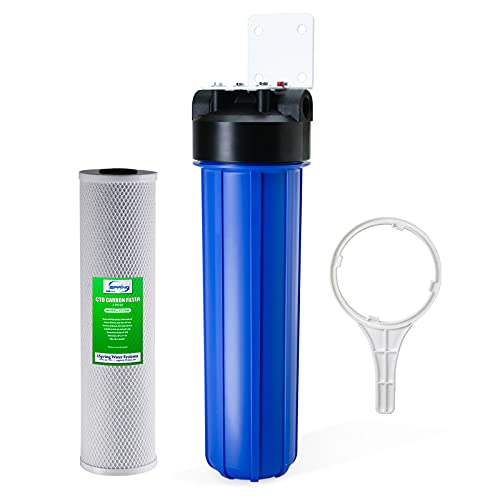
For a detailed performance analysis, look at our full iSpring WGB21B-PF review.
You can see a detailed breakdown in our full iSpring Whole House Filter review.
How specific water contaminants affect the lifespan of filtration media
The filtration capacity also dictates the frequency of maintenance. A higher capacity means the time between required media replacements is extended. However, if your water contains high levels of heavy sediment or specific contaminants, the actual lifespan of the media may be shorter than the manufacturer’s stated capacity. In these cases, the material’s ability to trap specific particles becomes the limiting factor rather than the total volume of water processed. You must ensure that the capacity listed in the specifications aligns with your specific water quality and the intended duration of use before you commit to a system.
We provide a comprehensive look at the APEC 3-Stage Whole House Water Filter system.
Median and maximum filtration capacities found in 52 product listings
In our research of 52 whole house water filtration listings, we found that the median filtration capacity stated by manufacturers is 100,000 Gallons. However, the range is broad, with some systems starting as low as 15,000 Gallons and others reaching 250,000 Gallons. Because these figures are provided by the manufacturers to describe the maximum treatment volume before replacement, they should be viewed as a maximum potential rather than a guaranteed duration of service. Your actual usage and local water conditions will determine how quickly you reach that limit.
Detailed specifications are available in our full Home Master HMF2SmgCC review.
Where to go next in our whole house water filtration coverage
- Whole House Water Filters for Heavy Metals Compared
- Choosing the Best Whole House Water Filter for Chloramine
- The Whole House Water Filters That Work Best for Hard Water Scale
- Which Whole House Water Filter Is Best for Iron and Manganese?
- Best Whole House Water Filters for Sediment and Rust
- Whole House Water Filters for Chlorine and Odor Compared