
Green Writer is reader-supported: some links on this page are affiliate links, and as an Amazon Associate Green Writer earns from qualifying purchases at no extra cost to you. Learn more.
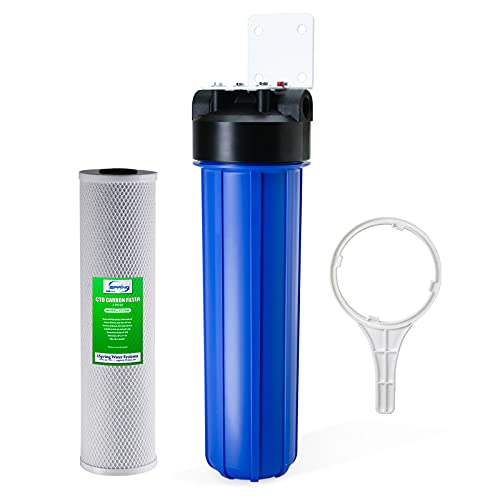
Inlet/outlet size for whole house water filtration refers to the diameter of the plumbing connections where the system joins your home’s water lines. Your specific plumbing setup, typically determined by the age and type of your home’s main water line, dictates which size you must select.
If your primary concern is groundwater quality, view our guide for well water smell to see how filtration helps.
Which Inlet/Outlet Size Suits Your Home?
| If this is you | The Inlet/Outlet Size that suits you | Why |
|---|---|---|
| You have a standard modern residential home | 1″ | This is the median size found in 29 of the 52 whole house water filtration systems evaluated in our research. |
| You have older plumbing or specific regional piping | 0.75″ | Smaller connections are common in older residential builds where the main line diameter is restricted. |
| You are installing a high-flow commercial-grade system | 1.5″ | Larger diameters accommodate higher volumes of water moving through the filtration media at once. |
| You are unsure of your pipe diameter | 1″ | Most standard residential fittings are designed to accommodate 1″ connections as a baseline. |
Whole House Water Filtration Systems covered by our own reviews
Prices across these 3 run from $131.99 to $547.99; each one has a full review here.
You should see the best whole house water filter for PFAS removal to ensure your drinking water is free from “forever chemicals.”
For those concerned about toxicity, compare the best whole house water filter for heavy metals to find a safe solution.


How Do I Find My Correct Inlet/Outlet Size?
To find your correct inlet/outlet size, you must identify the diameter of the existing pipe where the filtration system will be installed. Locating the main water shut-off valve or the point where the main line enters the home provides the best starting point for this measurement.
To ensure your municipal supply is safe, find the best whole house water filter for chloramine today.
If you are on a budget, find the best whole house water filter for hard water scale under 500 dollars to prevent mineral buildup.
Measuring the physical pipe diameter
Use a tape measure or a caliper to measure the outside diameter of the pipe. If the pipe is threaded, measure the distance across the widest part of the threads. Most residential pipes will measure between 0.75″ and 1.5″ in diameter. If you cannot access the pipe directly, look for the existing brass or PVC fittings; the size is often stamped into the metal or molded into the plastic.
Homeowners dealing with orange staining should examine the best whole house water filter for iron and manganese for clear water.
To eliminate debris from your pipes, compare the best whole house water filter for sediment and rust before you buy.
Identifying the thread type and size
The size is usually expressed in inches, such as 3/4″ or 1″, and refers to the nominal diameter. For whole house water filtration, the 1″ size is the most common standard. If you find a 3/4″ pipe, you will need a system that supports 0.75″ connections or use a plumbing adapter to transition the connection to a larger size. Because a mismatch can result in a costly return or a required plumbing rebuild, confirming this measurement before ordering is the most reliable way to ensure a correct fit.
If you want to improve the taste of your tap water, view our ranking for chlorine and odor results.
You can determine your required filtration capacity to ensure your system handles your home’s daily water flow.
What Happens if the Inlet/Outlet Size is Incorrect?
An incorrect inlet/outlet size creates a physical mismatch between the filtration unit and your home’s plumbing. If the filtration system’s ports are smaller than your home’s pipes, you will be forced to use reducers, which can create points of potential pressure drop or leakage.
It is also helpful to understand the necessary filter media diameter for your specific plumbing setup.
The consequences of a size that is too small
When the inlet/outlet size is too small for your home’s main line, the system creates a bottleneck. This restriction limits the volume of water that can pass through the filter at any given moment. You might notice a noticeable drop in water pressure at your showers or faucets when multiple fixtures are running simultaneously. This occurs because the smaller pipe cannot move the required volume of water as quickly as the larger main line provides it.
Make sure to verify the PFAS reduction rate of your system to meet your specific safety goals.
Always review the certifications and safety standards to ensure your filtration unit meets industry requirements.
The consequences of a size that is too large
If the filtration system’s ports are larger than your home’s pipes, the connection becomes physically impossible to join without significant modification. You cannot easily thread a larger fitting onto a smaller pipe. This mismatch often leads to a failed installation where the unit cannot be mounted to the plumbing, necessitating a return of the product or a professional plumbing intervention to resize the existing lines.
You can learn about the types of whole house water filtration systems to see which configuration fits your needs.
New users can see how a whole house water filtration system works to understand the basic mechanics of the technology.
What Should I Do if My Pipe Falls Between Two Sizes?
If your measurement falls between standard sizes, such as a 7/8″ pipe, you must decide whether to use an adapter or choose a different system. In most residential whole house water filtration scenarios, it is safer to select a system with a slightly larger inlet/outlet size and use a high-quality plumbing adapter.
To manage your budget, see what each price level gets you when investing in a new filtration setup.
If a whole system is too costly, explore the alternatives to a whole house water filtration system for different results.
Using adapters for non-standard sizes
A plumbing adapter acts like a bridge between two different sized roads, allowing water to flow from a smaller pipe into a larger fitting. If your pipe is 0.75″ and the most suitable filtration system uses 1″ connections, a 3/4″ to 1″ brass adapter is the standard solution. This ensures the filtration unit remains compatible with standard 1″ hardware while maintaining a secure seal on your existing plumbing.
For a deeper look at this specific brand, see our full Aquasana Whole House Filter review for detailed specs.
You might also want to view the Aquasana Whole House Water Filter spec breakdown before making a final decision.
When you must choose a different system
If the gap between your pipe size and the available system sizes is too large, you should avoid using multiple adapters. Using more than one transition point increases the risk of bypass leakage or pressure loss. In these rare cases, it is more reliable to select a filtration system that explicitly states it supports the smaller 0.75″ diameter, or to have a qualified installer replace the section of pipe leading to the filtration unit to match the 1″ standard.
If you prefer a compact option, see our full Express Water Essential review to see its performance.
The rest of our whole house water filtration guides
- Best Whole House Water Filters for Sediment and Rust
- Whole House Water Filters for Chlorine and Odor Compared
- Choosing the Best Whole House Water Filter for Large Families
- Removing Well Water Smell With a Whole House Water Filter
- Best Whole House Water Filters for PFAS Removal
- Whole House Water Filters for Heavy Metals Compared