
Green Writer is reader-supported: some links on this page are affiliate links, and as an Amazon Associate Green Writer earns from qualifying purchases at no extra cost to you. Learn more.
Coefficient of Performance (COP) for above ground pool heaters should target a range of 4.0 to 6.0 Ratio for standard residential use. You should look for a COP of 5.6 Ratio or higher to ensure the system produces more heat energy than the electrical energy it consumes during a typical heating cycle.
Recommended Coefficient of Performance (COP) Values
| Use Case | Recommended Coefficient of Performance (COP) | Why this number |
|---|---|---|
| Standard Backyard Heating | 4.5 to 6.0 Ratio | Provides a balance between efficient heat production and reasonable unit cost. |
| Extended Season Warming | 5.0 to 7.0 Ratio | Higher efficiency reduces the operating cost of running the heater daily for months. |
| High-Volume Turnover | 4.0 to 5.5 Ratio | Focuses on moving large volumes of water where high-efficiency heat exchange is secondary to flow. |
| Off-Peak Night Heating | 6.0+ Ratio | Maximizes heat output per unit of electricity during specific timed windows. |
Products in this category with a full review here
Prices across these 3 run from $539 to $1299; each one has a full review here.
If you are limited by your home’s power supply, compare options for an above ground pool heater for 110v outlet.


What happens if you underbuy or overbuy on COP?
Underbuying on the Coefficient of Performance (COP) means selecting a system that converts electricity into heat less efficiently. If you select a unit with a COP below 4.0 Ratio, the system will consume more electricity to reach the same water temperature as a more efficient model. This results in higher monthly electricity bills and may cause the unit to run for longer durations, increasing the wear on the internal components. For a backyard pool heater, a low COP means the energy cost of maintaining a comfortable temperature becomes a significant ongoing expense.
Understanding your budget is essential, so view what above ground pool heaters cost at different price points.
High COP ratings may lead to unnecessary upfront costs for pool heaters
Overbuying on the Coefficient of Performance (COP) involves paying a premium for high-efficiency ratings that your specific heating needs do not require. While a COP of 10.0 Ratio sounds ideal, the cost to manufacture and ship such high-efficiency heat exchangers often exceeds the savings gained over the lifespan of the unit. If your pool only requires a few hours of heating per day, the difference in energy cost between a 5.0 Ratio and a 7.0 Ratio system may be negligible compared to the higher upfront purchase price of the high-efficiency model. You may end up paying for efficiency that you never actually utilize.
Ensure your pump can handle the heat by learning how to choose your flow rate for above ground pool heaters.
The mistake most buyers make with COP and what to optimize instead
The mistake most buyers make with Coefficient of Performance (COP) is treating it as the sole indicator of how quickly a pool will warm up. A high COP only measures the efficiency of the heat exchange, not the total volume of heat the system can move in one hour. A unit with a high COP but a low heating capacity will take much longer to raise the temperature of a large pool than a lower-efficiency unit with a massive heat output.
Protecting your investment is vital, so review above ground pool heater warranties before you commit to a purchase.
Prioritizing heating capacity over COP ensures faster pool water warming
You should optimize for Heating Capacity instead of focusing exclusively on the COP ratio. Heating Capacity measures the total amount of heat energy produced per hour, which is the primary factor in how quickly you can move from a cold pool to a usable temperature. If you need to heat a large volume of water quickly, a unit with a 4.5 Ratio and a high heat output is often more practical than a 7.0 Ratio unit that has a limited heat output. Balance the efficiency of the COP with the raw power of the heating capacity to match your specific pool volume.
How COP interacts with other above ground pool heater specs
The Coefficient of Performance (COP) interacts with the heating capacity of the above ground pool heater by defining the relationship between power draw and heat output. A high COP figure is often wasted if the maximum heating capacity of the unit is lower than what your pool volume requires. For example, if your pool requires 18,000 BTU of heat per hour to maintain temperature, a high-efficiency heater that only produces 10,000 BTU will never keep up, regardless of how efficient its COP ratio is.
To understand the technology behind the hardware, explore the different types of above ground pool heaters.
Proper water flow and voltage maintain rated pool heater efficiency
COP also interacts with the operating voltage and the flow rate of the water. Because COP measures the efficiency of the heat exchange, it is dependent on the water moving through the heat exchanger at a consistent rate. If the flow rate is too low, the heat exchanger can overheat, which may cause the system to trigger a thermal safety shutdown, regardless of the COP rating. You must ensure that the pump provides enough flow to support the heat output of the heater. Furthermore, the operating voltage determines the electrical pressure available to the system; a high COP is only achievable when the system receives the correct voltage to run the compressor or heat exchange components at their rated efficiency.
For a deeper dive into that specific model, see our full review of the EU-PLC57100-E Heat Pump.
How to calculate your required heating speed
When you notice your pool temperature dropping overnight, the speed at which the heater can recover that heat is determined by its heating capacity. To determine if a heater is sufficient, you must know the total volume of your pool in gallons. A larger volume requires a higher heating capacity to reach a target temperature in a reasonable timeframe, such as four hours of operation.
You can find a detailed analysis of the unit in our full review of the V7 Plus Heat Pump.
Pool gallon volume determines the balance between heating capacity and COP
Check the total gallon volume of your pool before selecting a heater. If your pool exceeds 10,000 gallons, you must prioritize a high heating capacity over a high COP to ensure the water warms up before the next day. If your pool is smaller, such as 5,000 gallons, a high COP becomes more relevant as you can rely on a smaller, more efficient unit to maintain the temperature with lower energy costs.
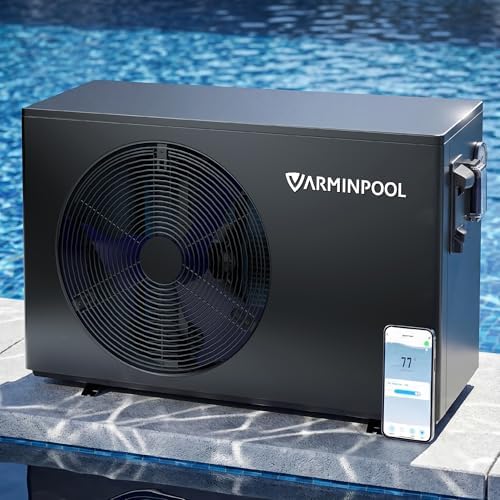
We provide a comprehensive breakdown in our full review of the VARMINPOOL Heat Pump.
The limits of COP in extreme weather
The Coefficient of Performance (COP) for above ground pool heaters is most effective when the ambient air temperature is relatively mild. In extremely cold conditions, the efficiency of a heat pump drops because the system has to work harder to extract heat from cold air. In these scenarios, the COP ratio will decrease, and the heating capacity may also be limited by the design of the heat exchanger.
Check out our detailed technical analysis in our full review of the AQUASTRONG HEX012-001.
High heating capacity supports pool warming in freezing winter temperatures
If you live in a climate where you need to heat the pool in freezing temperatures, look for a unit with a robust heating capacity that can handle high-load demands. While a high COP is great for maintaining a warm pool in the summer, it may not be the deciding factor for heavy-duty heating in the winter. In cold weather, the absolute amount of heat produced per hour becomes the most critical number for your decision.
Every above ground pool heater guide in this category
- The Above Ground Pool Heaters That Make a Small Pool Usable in Cold Weather
- The Above Ground Pool Heat Pumps That Work Best for Small Pools
- Which Pool Heat Pump Is Best for a 5500 Gallon Pool?
- Best Above Ground Pool Heater for Heating and Cooling
- Energy Efficient Pool Heat Pumps Compared
- Choosing the Best Above Ground Pool Heater for 110v Outlet