
Green Writer is reader-supported: some links on this page are affiliate links, and as an Amazon Associate Green Writer earns from qualifying purchases at no extra cost to you. Learn more.
Whole house water filtration is a system that treats the water supply for an entire residence at the main entry point. You need a system that matches your home’s flow rate and specific contaminant concerns, such as sediment or PFAS, to ensure consistent water quality. Measure your home’s incoming water pressure and identify your primary water source to determine which filtration stages and housing materials suit your plumbing setup.
If your primary concern is metallic staining, see the best whole house water filter for iron and manganese.
Whole House Water Filtration Capability Terms
- Filtration Stages – This is the number of successive filtration steps the water passes through; more stages generally indicate a wider range of removed contaminants.
- Filtration Type – This describes the specific method used to treat water, such as sediment removal or carbon block filtration, to target specific pollutants.
- PFAS Reduction Rate – This measures the percentage of per- and polyfluoroalkyl substances removed from the water; a higher percentage, such as 99%, indicates more effective chemical removal.
- Filtration Capacity – This is the total volume of water, often measured in gallons, that the filter can treat before the media becomes exhausted and requires replacement.
- NSF/ANSI 42 – This is the industry standard for aesthetic effects like chlorine, taste, and odor reduction; it confirms the system improves the sensory experience of the water.
- NSF/ANSI 53 – This is the certification required for health-related contaminants like lead and mercury; you need this standard if your goal is to remove specific toxic substances.
- NSF/ANSI 58 – This is the standard for reverse osmosis systems, which are distinct from whole house filtration and typically used for drinking water at a single tap.
Understanding Filtration Capacity and Flow
Filtration capacity is the most significant long-term cost factor for a whole house water filtration system. While the median capacity among the options we evaluated is 100,000 gallons, some systems offer up to 250,000 gallons. A higher capacity means you will replace the internal media less frequently. If you have a large household with high water usage, a lower capacity figure will result in more frequent maintenance and higher recurring costs for replacement cartridges.
To handle high-particle debris, browse the best whole house water filter for sediment and rust.
PFAS Reduction and Chemical Treatment
The PFAS reduction rate specifies how much of these “forever chemicals” the system can strip from your supply. We found that 9 of the options we evaluated state a specific reduction rate, with most reaching the 99% mark. Because PFAS are difficult to remove, a higher percentage is the only metric that matters for this specific contaminant. If a listing does not state a reduction rate, it may not be designed to address these specific chemicals effectively.
For those concerned about “forever chemicals,” find the best whole house water filter for PFAS removal.
Where these choices show up in our reviews
Each of the 3 shown here has its own full review on this site; they run from $527.99 to $1310.99.
You can see the best whole house water filter for heavy metals compared in our full analysis.
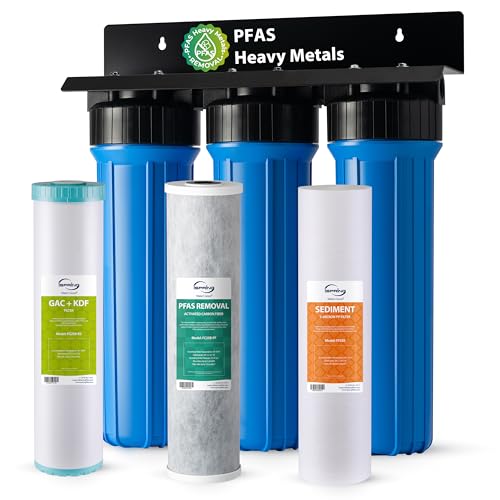


Whole House Water Filtration Physical Terms
- Inlet/Outlet Size – This is the diameter of the plumbing connections, typically measured in inches; you must match this to your home’s existing pipe size, which is often 1 inch.
- Filter Media Diameter – This is the width of the internal filtration material, such as a 10-inch core; a larger diameter generally allows for more surface area and a slower rate of pressure drop.
- Housing Material – This is the substance used to build the outer shell, such as Polypropylene, Stainless Steel, or PVC; different materials offer different levels of durability and chemical resistance.
- Housing Unit – This is the physical container that protects the filter media and contains the pressurized water during the filtration process.
- Sediment Filter – This is a component that removes large particles like sand and rust before they can clog finer filters in the system.
- Carbon Block – This is a dense filter material that adsorbs chemicals like chlorine to improve the taste and odor of your water.
Housing Materials and Connection Sizes
The housing material determines how the system withstands daily water pressure and chemical exposure. While many systems use Polypropylene, some utilize Stainless Steel or PVC. For a whole house water filtration system, the housing must be rated to handle your home’s specific PSI. You should verify that the inlet and outlet sizes, which often range from 0.75 to 1.5 inches, match your plumbing. A mismatch here requires expensive adapters or professional plumbing modifications to complete the installation.
Understanding your options is easier when you explore the different types of whole house water filtration systems.
If a full system isn’t right for you, view alternatives to a whole house water filtration system for similar results.
Sediment and Carbon Filter Functions
A sediment filter acts as the first line of defense by trapping physical debris like rust and grit. By removing these large particles first, the sediment filter prevents the carbon block from clogging prematurely. The carbon block then performs the chemical work, adsorbing chlorine and other organic compounds. Using both in a multi-stage setup ensures that the water remains clear and tastes neutral throughout the house.
Protect your investment by reviewing how whole house water filtration system warranties typically work.
Whole House Water Filtration Compatibility Terms
- Replacement Cartridge – This is the internal filter media that you must purchase to ensure the system continues to filter water after the initial media is exhausted.
- Bypass Valve – This is a plumbing component that allows water to flow to the house while the system is being serviced or the filters are being changed.
- Pressure Gauge – This is a tool that monitors the pressure drop across the system to indicate when the filters are clogged and need replacement.
- SGS-Tested – This is a third-party verification that the product has undergone specific laboratory testing, though it is not a replacement for NSF certifications.
- Point of Entry – This is an installation location where the filtration happens at the very start of the plumbing system, before the water reaches any fixtures.
- Wall Mount – This is a mounting style where the housing unit is secured to a wall rather than sitting on the floor or a countertop.
Essential Maintenance and Service Parts
Maintaining a whole house water filtration system requires specific spare parts to keep the water flowing. A bypass valve is a critical component for any homeowner, as it allows you to shut off the filter for maintenance without turning off the water to the entire house. You should also consider a pressure gauge; by monitoring the pressure drop, you can identify exactly when the sediment filter is full. Without a gauge, you may have to guess when the flow rate has decreased enough to require a new replacement cartridge.
For a deep dive into the entry-level model, look at our full Express Water Essential spec breakdown.
Common Whole House Water Filtration Confusions
Buyers often confuse whole house water filtration with reverse osmosis, but these systems serve different purposes. Whole house water filtration treats the water for the entire plumbing system, including showers and laundry, while reverse osmosis is typically a point-of-use system for drinking water. Another common confusion involves filtration capacity and flow rate. Filtration capacity measures the total volume of water a filter can treat before it dies, while flow rate measures how many gallons per minute the system allows through. A high-capacity filter might still have a slow flow rate if the filter media diameter is too small for your home’s needs.
You can view how the Express Water WH100SC performs in our detailed analysis.
Finally, many people mistake “SGS-Tested” for “NSF Certified.” While both involve testing, NSF/ANSI 42 and 53 are the recognized industry standards for water safety and performance. If a listing only mentions SGS, it may not meet the specific requirements for removing lead or mercury that the NSF 53 standard guarantees.
Discover how the Hardless NG4L Filter performs in our detailed data review.
Browse our other whole house water filtration pages
- Best Whole House Water Filters for Sediment and Rust
- Whole House Water Filters for Chlorine and Odor Compared
- Choosing the Best Whole House Water Filter for Large Families
- Removing Well Water Smell With a Whole House Water Filter
- Best Whole House Water Filters for PFAS Removal
- Whole House Water Filters for Heavy Metals Compared