
Green Writer is reader-supported: some links on this page are affiliate links, and as an Amazon Associate Green Writer earns from qualifying purchases at no extra cost to you. Learn more.
Whole house water filtration provides a system of treatment for the entire plumbing network of a residence to remove contaminants like chlorine, sediment, and heavy metals. You need a whole house system when your water quality issues affect every tap, shower, and appliance in the home, typically involving a flow rate requirement of 10 to 20 gallons per minute. Measure your home’s peak demand, such as running two showers and a dishwasher simultaneously, to determine if a single main line system provides sufficient volume for your needs.
If your local supply contains high levels of nitrogen-based disinfectants, see our top picks for chloramine removal.
How do point-of-use filtration systems compare to whole house water filtration?
Point-of-use filtration systems provide water treatment at specific locations, such as a kitchen sink or a dedicated shower head, rather than at the main water entry point. These systems are often more cost-effective initially because they require less plumbing work and smaller housing units. If you only have concerns about the taste of drinking water or the feel of water on your skin in one room, a point-of-use system provides a targeted solution without treating the entire home’s volume. These units often use carbon blocks or specialized filters to target specific contaminants like lead or chlorine.
To address physical debris in your pipes, browse our top-rated sediment and rust filters.
Limitations of point-of-use systems for protecting household appliances
A point-of-use system becomes less practical when you need to protect high-use appliances from scale or sediment buildup. For example, if you have a dishwasher that frequently clogs or a washing machine that leaves mineral deposits on clothes, a sink-side filter will not prevent those issues. You would need to install separate units at every appliance, which increases the complexity of maintenance and the number of filters to replace. These systems are best for renters or homeowners who only need to improve water quality for drinking and cooking.
If your primary concern is a chemical scent, view our comparison of chlorine and odor filters.
Where these choices show up in our reviews
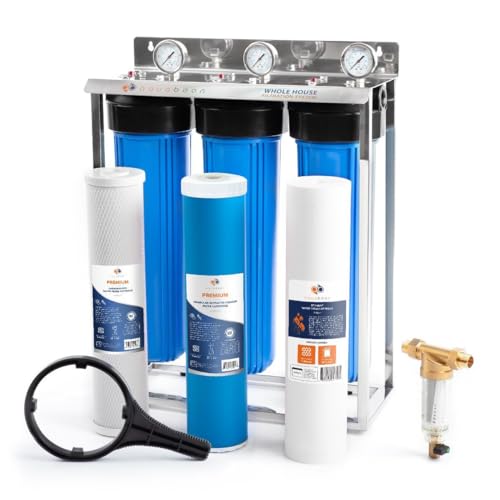
3 options shown here, $169.90 to $996.55, each with its own full review behind its name.
High-volume households should consult our guide for large family water systems.


Can water softening chemicals replace a whole house water filtration system?
Water softening chemicals involve adding substances like sodium carbonate or specialized salts to the water supply to manage hardness and mineral content. This method is often used in areas where the primary concern is limescale buildup on fixtures and inside pipes. Compared to a mechanical filtration system, chemical treatment can be cheaper to install but requires a consistent supply of chemicals and regular monitoring of the water chemistry. This route is often chosen in regions with very high mineral content where standard carbon filtration cannot prevent heavy scale formation.
To eliminate earthy notes from private wells, explore various whole house water filters for well water smell.
Why chemical treatments fail to remove sediment and physical debris
Chemical treatment stops being effective when the primary goal is the removal of particulates, sediment, or specific industrial chemicals like PFAS. While minerals are neutralized, physical debris remains in the water, which can still damage valves and aerators. Buyers often make the mistake of choosing chemicals to fix “dirty” looking water, only to find that the sediment remains because the chemical treatment does not provide mechanical filtration. If your water contains visible particles or high levels of chlorine, a mechanical filtration system is required alongside or instead of chemical additives.
For those concerned about “forever chemicals,” see the best whole house water filter for PFAS removal.
What is the role of municipal water treatment in home filtration?
Municipal water treatment refers to the large-scale purification process managed by a city or utility provider before water reaches your home’s main line. This system uses a combination of sedimentation, aeration, and chemical disinfection to meet safety standards for the general population. If your local utility already provides water that meets your aesthetic and safety requirements, you may not need to install any additional filtration at your property. Many residents rely on this infrastructure because it is the most cost-effective way to receive treated water without personal equipment maintenance.
Make sure you understand the technical side by viewing our plain English filtration terms and specs guide.
When municipal water treatment requires a private whole house system
Municipal treatment is not a guarantee of specific water qualities, such as the removal of all trace minerals or specific local contaminants. If your local water source is a private well or a poorly maintained municipal line, the treatment may be insufficient for your specific needs. You should check your local water quality report to see if the utility treats for lead, nitrates, or hardness. If the report shows high levels of these substances, a private whole house system becomes necessary to supplement the municipal treatment provided to your home.
You can learn about different technologies by viewing the various types of whole house systems explained.
Are refurbished units a viable alternative for whole house water filtration?
Refurbished units are pre-owned whole house water filtration systems that have been inspected, cleaned, and restored to functional condition by a third party. This option allows for a lower entry price compared to purchasing a new system with a full manufacturer warranty. Refurbished systems are often suitable for homeowners on a strict budget who still require the benefits of whole-house treatment but want to avoid the “new” premium. Because these systems are often large and heavy, they are typically sold as complete units rather than individual components.
New homeowners can learn about the basic mechanics by reading how whole house filtration systems work.
Risks of buying refurbished units with exhausted filtration media
Refurbished units stop making sense when the internal media, such as the carbon or sediment core, has reached its end of life or has been improperly cleaned. Since the filtration capacity is based on the volume of water processed, a used system may have had its primary media exhausted by a previous owner. You should verify the age of the unit and the condition of the internal housing to ensure it can handle your home’s flow requirements. If the unit is from a discontinued model, finding replacement parts or compatible filter cartridges can become difficult and expensive over time.
To manage your budget effectively, see our breakdown of whole house system costs.
Comparison of different whole house water filtration alternatives
| Route | Who it suits | Main advantage | Where it breaks down |
|---|---|---|---|
| Point-of-use systems | Renters or those with localized needs | Low installation cost | Does not protect whole-home plumbing |
| Softening chemicals | Homes with high mineral/hardness levels | Prevents limescale buildup | Does not remove sediment or chemicals |
| Municipal treatment | Residents with high-quality city water | No maintenance or equipment costs | Variable quality depending on location |
| Refurbished units | Budget-conscious homeowners | Lower initial purchase price | Potential for limited media life |
When is buying a new whole house water filtration system the right choice?
Buying a new whole house water filtration system is the correct choice when you require consistent, high-volume treatment for every fixture in the home. This is necessary if you have a high flow rate requirement, such as 15 gallons per minute, or if you need to remove a wide range of contaminants simultaneously. If you are dealing with a combination of sediment, chlorine, and heavy metals, a single-point solution at the main line ensures that every drop of water entering the house is treated. This provides the most comprehensive protection for your plumbing and appliances.
You can find a detailed technical analysis in our full Aquaboon Basic Filter review.
Benefits of new systems for specific certifications and known service life
A new system is also the right choice when you need a specific certification, such as NSF/ANSI 53 for health-related contaminants, which is often not guaranteed by refurbished or chemical-only options. If your water contains specific chemicals that require a high filtration capacity, a new system allows you to select the correct media for that specific task. While the initial cost is higher, a new system provides a known starting point for the filter’s service life, ensuring you know exactly how much water the media can process before it needs replacement.
For a deep dive into these specific specs, see our full Waterdrop WD-WHF3T-FG review.
More whole house water filtration explainers and comparisons
- Whole House Water Filters for Chlorine and Odor Compared
- Choosing the Best Whole House Water Filter for Large Families
- Removing Well Water Smell With a Whole House Water Filter
- Best Whole House Water Filters for PFAS Removal
- Whole House Water Filters for Heavy Metals Compared
- Choosing the Best Whole House Water Filter for Chloramine